
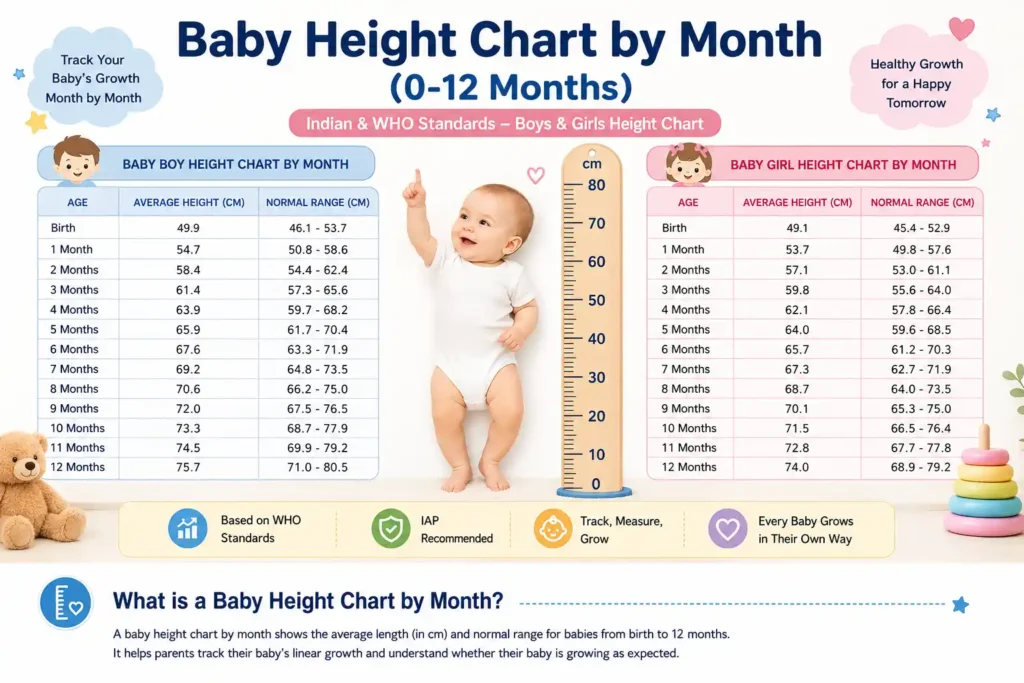
Baby Height Chart Month by Month (0-12 Months): Indian & WHO Standards
Every parent loves watching their baby grow, and while weight often takes center stage at pediatrician visits, tracking your baby’s length is equally important. It is natural to look at your little one and wonder, “Are they growing tall enough? Is their height normal for their age?”
This comprehensive baby height chart will help you track your child’s linear growth month by month. Whether you are looking for an Indian baby height chart or global benchmarks, this guide covers everything you need to know to ensure your baby is developing perfectly. If you want a quick and easy way to track your child’s overall percentiles, try using our free baby growth calculator.
Table of Contents
- Why Monitoring Your Baby’s Height Matters
- WHO vs. IAP: Are Indian Babies Measured Differently?
- Baby Length vs. Height: What’s the Difference?
- Baby Boy Height Chart (0-12 Months)
- Baby Girl Height Chart (0-12 Months)
- Understanding Your Baby’s Growth Percentile
- How to Measure Your Baby’s Length at Home
- Common Mistakes When Measuring Baby Length at Home
- What Factors Affect a Baby’s Height?
- When Should You Consult a Pediatrician?
- Medical Disclaimer
- Frequently Asked Questions (FAQs)
- Sources & References
Why Monitoring Your Baby’s Height Matters
Tracking your baby’s length is not just about guessing how tall they will be as adults; it is a vital indicator of their overall health and nutrition. Pediatricians use height measurements alongside weight to calculate growth percentiles and ensure your baby is growing proportionally.
While it is easy to compare your baby to others of the same age, remember that consistent, steady growth on their own curve matters far more than matching another baby’s height. A healthy baby growing at their natural pace is exactly what you want to see.
WHO vs. IAP: Are Indian Babies Measured Differently?
A very common question among parents is whether the average height of an Indian baby differs significantly from babies in the US or UK. The short answer is: No, the standards are the same.
The Indian Academy of Pediatrics (IAP) officially recommends using the World Health Organization (WHO) Child Growth Standards for all children from birth to 5 years of age. The WHO charts were developed by studying healthy, breastfed infants from various global populations under optimal environmental conditions.
This means that a healthy baby in India has the exact same growth potential as a healthy baby anywhere else in the world during their first five years. Therefore, this baby length chart applies universally.
Baby Length vs. Height: What’s the Difference?
You might hear your pediatrician refer to your baby’s “length” rather than “height.” Medically, there is a technical difference based on how the measurement is taken.
For babies under 2 years of age, the measurement is taken while they are lying flat on their back. This is called length. Once a child turns 2 and can stand independently against a wall, the measurement is taken standing up, which is then formally called height. In everyday conversation, parents use both terms interchangeably, but pediatric charts for infants specifically refer to length.
Baby Boy Height Chart (0-12 Months)
Below is the standard height (length) chart for baby boys from birth to their first birthday. The “Average Height” represents the 50th percentile.
| Age | Average Height (cm) | Normal Range (cm) |
|---|---|---|
| Birth | 49.9 cm | 46.1 – 53.7 cm |
| 1 Month | 54.7 cm | 50.8 – 58.6 cm |
| 2 Months | 58.4 cm | 54.4 – 62.4 cm |
| 3 Months | 61.4 cm | 57.3 – 65.6 cm |
| 4 Months | 63.9 cm | 59.7 – 68.2 cm |
| 5 Months | 65.9 cm | 61.7 – 70.4 cm |
| 6 Months | 67.6 cm | 63.3 – 71.9 cm |
| 7 Months | 69.2 cm | 64.8 – 73.5 cm |
| 8 Months | 70.6 cm | 66.2 – 75.0 cm |
| 9 Months | 72.0 cm | 67.5 – 76.5 cm |
| 10 Months | 73.3 cm | 68.7 – 77.9 cm |
| 11 Months | 74.5 cm | 69.9 – 79.2 cm |
| 12 Months | 75.7 cm | 71.0 – 80.5 cm |
Baby Girl Height Chart (0-12 Months)
Below is the standard height (length) chart for baby girls from birth to their first birthday.
| Age | Average Height (cm) | Normal Range (cm) |
|---|---|---|
| Birth | 49.1 cm | 45.4 – 52.9 cm |
| 1 Month | 53.7 cm | 49.8 – 57.6 cm |
| 2 Months | 57.1 cm | 53.0 – 61.1 cm |
| 3 Months | 59.8 cm | 55.6 – 64.0 cm |
| 4 Months | 62.1 cm | 57.8 – 66.4 cm |
| 5 Months | 64.0 cm | 59.6 – 68.5 cm |
| 6 Months | 65.7 cm | 61.2 – 70.3 cm |
| 7 Months | 67.3 cm | 62.7 – 71.9 cm |
| 8 Months | 68.7 cm | 64.0 – 73.5 cm |
| 9 Months | 70.1 cm | 65.3 – 75.0 cm |
| 10 Months | 71.5 cm | 66.5 – 76.4 cm |
| 11 Months | 72.8 cm | 67.7 – 77.8 cm |
| 12 Months | 74.0 cm | 68.9 – 79.2 cm |
To track your baby’s weight alongside their height, refer to our comprehensive baby weight chart.
💡 Quick Growth Insight
Did you know? Babies grow incredibly fast in their first year—typically increasing their length by about 25 cm (10 inches)! Remember that growth often happens in sudden spurts rather than a slow, steady daily stretch.
Understanding Your Baby’s Growth Percentile
When you visit the pediatrician, they will plot your baby’s length on a growth chart and give you a percentile. But what does that actually mean?
If your baby girl is in the 75th percentile for length, it means she is longer than 75 out of 100 healthy baby girls of the same age, and shorter than 25. A percentile is not a health score or a test grade. A baby in the 15th percentile can be just as healthy as a baby in the 90th percentile.
Doctors look for growth trends. As long as your baby is roughly following their own curve and not suddenly dropping across multiple percentile lines, their growth is considered healthy and normal.
How to Measure Your Baby’s Length at Home
Unlike adults who can stand against a wall, babies under 2 years old are measured while lying down. Measuring a wriggly baby at home can be tricky, but you can get an accurate estimate by following these steps:
- Use a flat surface: Lay your baby down on their back on a firm, flat surface (like a clean floor or a changing table).
- Get a helper: It is much easier if one person gently holds the baby’s head straight while the other measures.
- Straighten the legs: Gently press your baby’s knees down so their legs are fully extended against the surface.
- Mark and measure: Use a soft measuring tape. Measure from the top of their head to the base of their heel. Alternatively, you can make a small pencil mark on a paper placed under their head and heel, then measure the distance between the marks.
Common Mistakes When Measuring Baby Length at Home
Because babies wiggle and kick, home measurements are often slightly inaccurate. Here are common mistakes to avoid:
- Bent knees: If your baby’s legs are slightly bent, the measurement will read shorter than they actually are. Gently but firmly press their knees down to flatten the leg.
- Tucked chin: If their head is tilted forward, it alters the length. Ensure they are looking straight up at the ceiling.
- Using a stiff ruler: A soft, flexible tailor’s measuring tape is much safer and more accurate for wrapping around a baby’s natural curves compared to a stiff metal tape measure.
What Factors Affect a Baby’s Height?
If your baby’s length falls in the higher or lower percentiles, do not panic. A baby’s height is influenced by several completely normal factors:
- Genetics: This is the most significant factor. Tall parents tend to have long babies, while petite parents tend to have shorter babies. If both parents are below average height, it is perfectly normal for their baby to track in the lower height percentiles.
- Nutrition: Adequate nutrition is essential for bone growth. A well-balanced diet of breastmilk or formula, followed by appropriate baby solid foods after 6 months, supports optimal linear growth.
- Sleep: Did you know babies literally grow in their sleep? Growth hormone is secreted primarily during deep sleep, making a healthy sleep schedule crucial for physical development.
- Premature Birth: Babies born early will be shorter than full-term babies of the same chronological age. They will follow an adjusted growth curve for the first few years. If your baby was born early, check our premature baby growth guide for more specific information.
- Hormonal and Medical Conditions: While less common, certain underlying health issues can affect a baby’s growth. Conditions such as thyroid disorders, growth hormone deficiency, or chronic illnesses can slow down linear growth. These are uncommon causes and require proper evaluation and diagnosis by a pediatrician.
When Should You Consult a Pediatrician?
While babies grow at their own unique pace, certain signs warrant a conversation with your pediatrician to rule out any underlying issues. Consult your doctor if you notice:
- Growth stops: Your baby’s length hasn’t increased at all over several consecutive months.
- Dropping percentiles: Your baby suddenly drops down two or more major percentile lines on their growth chart.
- Poor feeding and weight gain: A lack of linear growth accompanied by poor feeding, lethargy, or failure to gain weight.
- Delayed development: Slower physical growth combined with missing significant developmental milestones (like not rolling over or sitting up when expected).
Medical Disclaimer
The growth charts and developmental information provided in this article are for educational purposes only and are based on WHO standards. This content is not a substitute for professional medical advice, diagnosis, or treatment. Always consult your pediatrician with any concerns regarding your child’s growth and health.
Frequently Asked Questions (FAQs)
1. Is my baby’s height supposed to double in the first year?
No, a baby’s weight typically triples by their first birthday, but their height increases by about 50%. For example, a baby born at 50 cm will likely be around 75 cm tall at 12 months.
2. My baby’s weight is in the 80th percentile, but their height is in the 30th percentile. Is this normal?
Yes, this can be normal! Babies come in all shapes and sizes. Some are short and chunky, while others are long and lean. As long as your baby is steadily following their own curve on both the weight and height charts, pediatricians are usually not concerned.
3. Can a baby stop growing in length for a month?
Yes. Just like weight, babies grow in spurts. You might not notice any change in length for a few weeks, and then suddenly they might grow an entire centimeter in a matter of days. This is why doctors look at long-term trends rather than daily or weekly measurements.
4. What is the average height of a 6-month-old baby?
According to WHO standards, the average length for a 6-month-old baby boy is 67.6 cm, and for a 6-month-old baby girl, it is 65.7 cm.
5. What should I expect for my newborn’s height and weight?
Newborns grow rapidly in their first few weeks. To understand what is normal during this critical early phase, read our detailed newborn baby weight and growth guide.
6. What happens to their growth rate after they turn one?
After a baby’s first birthday, their growth rate naturally slows down compared to infancy. As they transition into the toddler phase, they will continue to gain height and weight steadily, but not at the rapid pace of their first year. If you are curious about toddler milestones, you can refer to our 2-year-old baby weight guide for what to expect next.
Comments
Be the first to leave a comment!