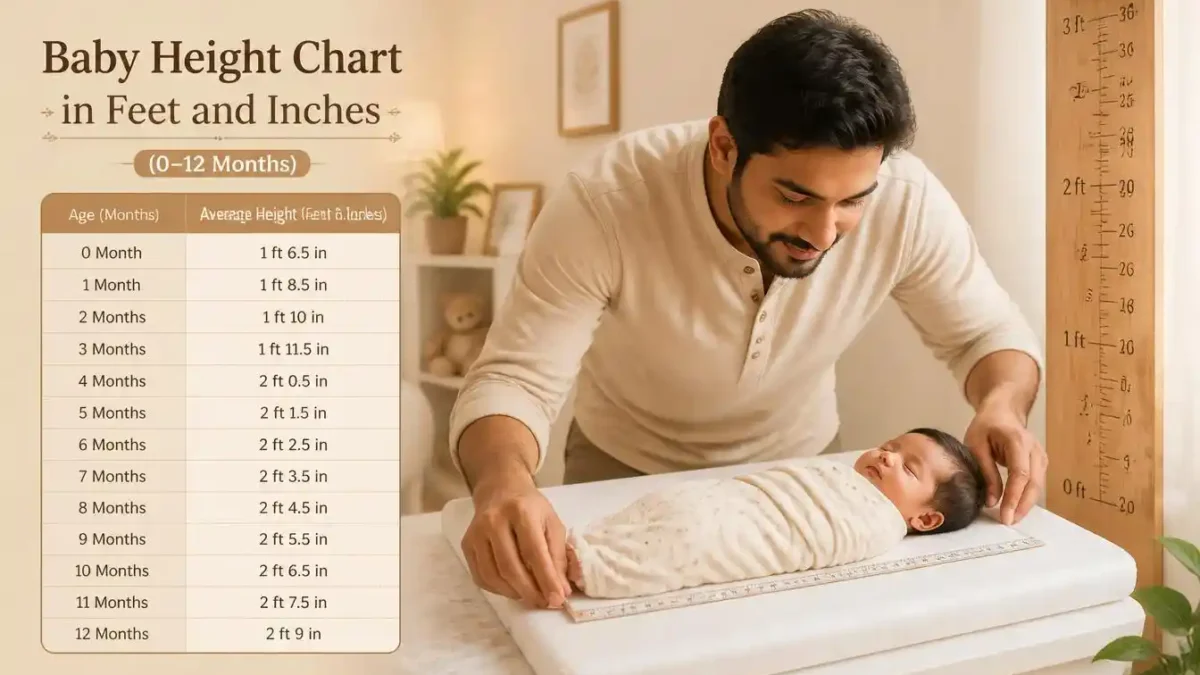
Baby Height Chart in Feet and Inches (0–12 Months): Month-by-Month Indian Reference
Most growth charts you find online — and the ones your pediatrician uses — show measurements in centimetres. That’s the clinical standard. But if you’re trying to picture what 67 cm actually looks like, or you’re sharing your baby’s measurements with family members who think only in feet and inches, you quickly realise those numbers don’t mean much without a conversion.
This reference gives you baby height in feet and inches directly — no calculator needed. The data is drawn from WHO Child Growth Standards (2006), the same figures your pediatrician references, with values converted into feet and inches for easy daily use. Whether you’re curious about your 4-month-old’s height in feet or wondering if your 10-month-old’s measurements are on track, this chart has the answers in the format that makes sense to you.
If you’d prefer to track your baby’s growth in centimetres, our baby height chart by month (0–12 months) covers the same data in cm with additional context about growth patterns.
Why Parents Still Use Feet and Inches
India officially uses the metric system, and medical charts follow suit. But in everyday conversation — especially in families with older generations or connections abroad — feet and inches remain the default unit for height. If your mother-in-law asks how tall the baby is, she’s probably not expecting an answer in centimetres.
There’s also the matter of those height ruler stickers and growth charts many families put on nursery walls. A good number of them are calibrated in feet and inches. Knowing your baby’s expected height range in those units helps you actually read and use what’s already on your wall.
The conversion itself is simple: 1 inch equals 2.54 cm. But doing that maths at 11 PM after a rough feeding is nobody’s idea of a good time — which is why having a direct reference chart is genuinely useful.
Baby Boy Height Chart in Feet and Inches (0–12 Months)
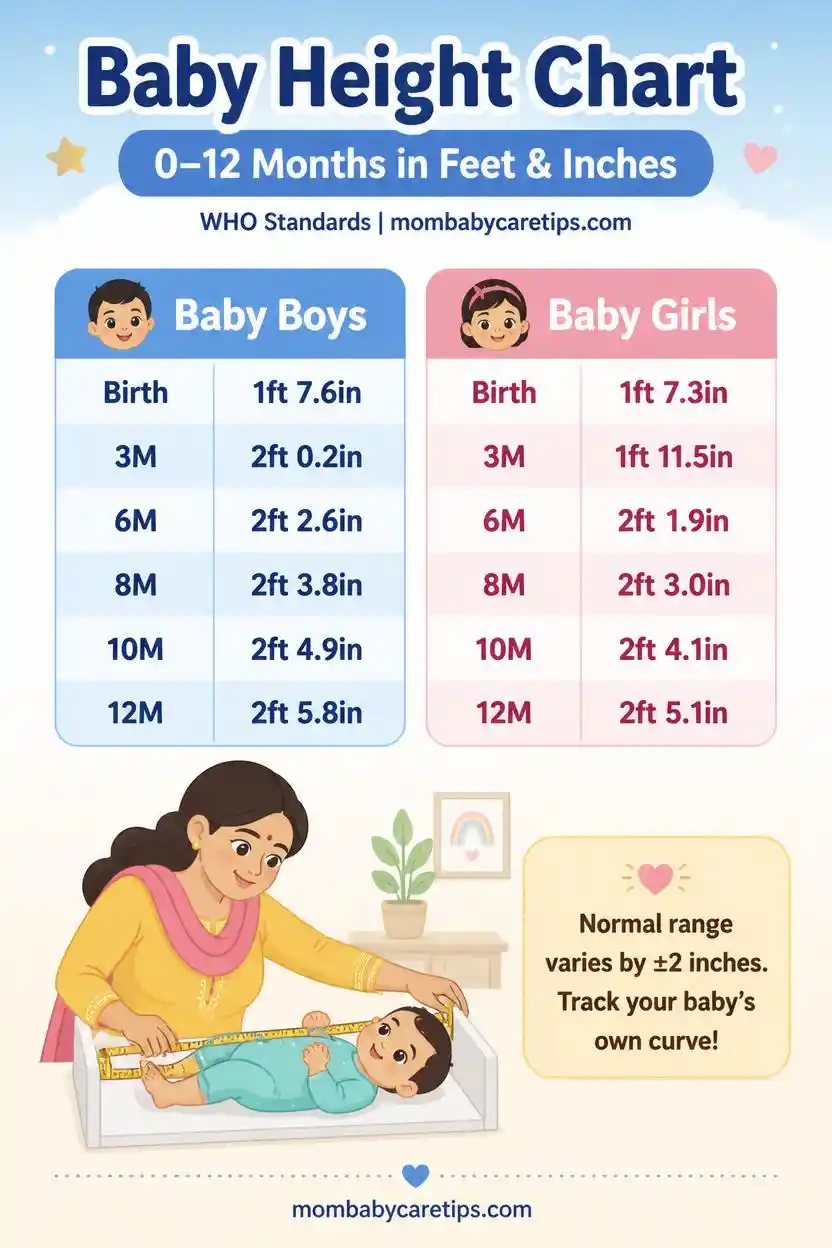
The table below shows average height for baby boys from birth to 12 months, based on WHO Child Growth Standards. The “Average” column is the 50th percentile. The normal range covers the 3rd to 97th percentile — any healthy, well-nourished baby can fall anywhere in this band.
| Age | Average Height | In Inches | Normal Range (inches) |
|---|---|---|---|
| Birth | 1 ft 7.6 in | 19.6 in | 18.1 – 21.0 in |
| 1 Month | 1 ft 9.5 in | 21.5 in | 19.9 – 22.9 in |
| 2 Months | 1 ft 11.0 in | 23.0 in | 21.4 – 24.5 in |
| 3 Months | 2 ft 0.2 in | 24.2 in | 22.3 – 26.0 in |
| 4 Months | 2 ft 1.2 in | 25.2 in | 23.2 – 27.1 in |
| 5 Months | 2 ft 1.9 in | 25.9 in | 24.1 – 27.9 in |
| 6 Months | 2 ft 2.6 in | 26.6 in | 24.6 – 28.6 in |
| 7 Months | 2 ft 3.2 in | 27.2 in | 25.2 – 29.2 in |
| 8 Months | 2 ft 3.8 in | 27.8 in | 25.7 – 29.8 in |
| 9 Months | 2 ft 4.3 in | 28.3 in | 26.1 – 30.4 in |
| 10 Months | 2 ft 4.9 in | 28.9 in | 26.6 – 30.9 in |
| 11 Months | 2 ft 5.3 in | 29.3 in | 27.0 – 31.5 in |
| 12 Months | 2 ft 5.8 in | 29.8 in | 27.6 – 32.0 in |
Source: WHO Child Growth Standards — Length/Height-for-Age (2006). Values converted from cm to feet/inches (1 in = 2.54 cm). Normal range = 3rd–97th percentile.
Baby Girl Height Chart in Feet and Inches (0–12 Months)
Baby girls are typically slightly shorter than boys of the same age in the first year, though the difference is small and both follow healthy growth curves. The ranges below reflect the natural variation seen across healthy, well-nourished children worldwide.
| Age | Average Height | In Inches | Normal Range (inches) |
|---|---|---|---|
| Birth | 1 ft 7.3 in | 19.3 in | 17.8 – 20.7 in |
| 1 Month | 1 ft 9.1 in | 21.1 in | 19.6 – 22.6 in |
| 2 Months | 1 ft 10.5 in | 22.5 in | 20.9 – 24.0 in |
| 3 Months | 1 ft 11.5 in | 23.5 in | 21.9 – 25.4 in |
| 4 Months | 2 ft 0.4 in | 24.4 in | 22.7 – 26.2 in |
| 5 Months | 2 ft 1.2 in | 25.2 in | 23.4 – 26.9 in |
| 6 Months | 2 ft 1.9 in | 25.9 in | 24.0 – 27.7 in |
| 7 Months | 2 ft 2.5 in | 26.5 in | 24.6 – 28.3 in |
| 8 Months | 2 ft 3.0 in | 27.0 in | 25.1 – 28.9 in |
| 9 Months | 2 ft 3.6 in | 27.6 in | 25.5 – 29.4 in |
| 10 Months | 2 ft 4.1 in | 28.1 in | 26.0 – 29.9 in |
| 11 Months | 2 ft 4.7 in | 28.7 in | 26.4 – 30.5 in |
| 12 Months | 2 ft 5.1 in | 29.1 in | 27.1 – 31.2 in |
Source: WHO Child Growth Standards — Length/Height-for-Age (2006). Values converted from cm. Normal range = 3rd–97th percentile.
Quick CM to Feet & Inches Conversion Reference
If your clinic gives you a cm reading and you want to convert it quickly, use the table below. These are the most common height ranges for babies in the first year.
| Centimetres (cm) | Inches (in) | Feet & Inches |
|---|---|---|
| 46 cm | 18.1 in | 1 ft 6.1 in |
| 50 cm | 19.7 in | 1 ft 7.7 in |
| 55 cm | 21.7 in | 1 ft 9.7 in |
| 60 cm | 23.6 in | 1 ft 11.6 in |
| 65 cm | 25.6 in | 2 ft 1.6 in |
| 70 cm | 27.6 in | 2 ft 3.6 in |
| 75 cm | 29.5 in | 2 ft 5.5 in |
| 80 cm | 31.5 in | 2 ft 7.5 in |
Formula if you need to calculate manually: cm ÷ 2.54 = inches. To convert inches to feet: divide by 12 for feet, and the remainder is inches.
Height at Key Months — What the Numbers Look Like
4-Month Baby Height in Feet
At 4 months, baby boys average around 2 ft 1.2 in (25.2 inches / 63.9 cm), and girls are close behind at about 2 ft 0.4 in (24.4 inches / 62.1 cm). This is roughly when most babies have settled into a consistent growth curve after the more erratic early weeks. The normal range at this age is wide — a healthy 4-month-old boy can measure anywhere from about 23 to 27 inches and still be on track.
5-Month Baby Height in Feet
By 5 months, boys are typically around 2 ft 1.9 in (25.9 in) and girls around 2 ft 1.2 in (25.2 in). This is not a dramatic jump from month 4 — growth in the second half of the first year is steadier and slower than those early explosive weeks. If your 5-month-old seems shorter or taller than what you see here, check the range column first before drawing conclusions.
8-Month Baby Height in Feet
At 8 months, average height is around 2 ft 3.8 in for boys (27.8 in / 70.6 cm) and 2 ft 3.0 in for girls (27.0 in / 68.7 cm). Many parents notice their baby growing visibly longer around this time — clothes that fit at 6 months suddenly seem short in the legs even if the weight is similar. That’s the first-year growth pattern doing its thing.
10-Month Baby Height in Feet and Inches
Ten months brings boys to around 2 ft 4.9 in (28.9 in / 73.3 cm) and girls to around 2 ft 4.1 in (28.1 in / 71.5 cm). A 10-month-old girl measuring 28 inches is right in the middle of the normal range — there’s nothing to worry about there. If your child is close to pulling up to stand at this age, you may actually notice slight differences in measured height depending on how relaxed they are during the measurement.
12-Month Height — Approaching the First Birthday
By 12 months, boys average 2 ft 5.8 in (29.8 inches / 75.7 cm) and girls average 2 ft 5.1 in (29.1 inches / 74.0 cm). Most babies roughly double their birth length in the first year — which, when you think about it, is a remarkable rate of growth that never happens again at that pace. If you want to continue tracking height month by month beyond the first year, our toddler height chart for 12–36 months picks up from exactly this point.
Are These Numbers Right for Indian Babies?
The WHO growth standards used here were developed from children across six countries, selected specifically because they were growing under optimal conditions — well-nourished, healthy, and with access to good care. The conclusion of that research was that when health and nutrition are adequate, children from diverse backgrounds reach very similar growth milestones in early childhood.
The Indian Academy of Pediatrics (IAP) endorses WHO 2006 growth standards for Indian children under 5 years, which is why these are the same numbers your pediatrician works from in India. A baby in Pune or Bhopal has the same height potential as a baby growing under similar conditions anywhere else in the world during this phase.
(Reference: Khadilkar et al., Indian Pediatrics 2015 — IAP Growth Charts Revised)
If your baby consistently falls below the 3rd percentile or above the 97th, that’s worth a conversation with your pediatrician — not because those numbers indicate a problem, but because your doctor can assess whether it reflects family genetics, feeding patterns, or anything worth looking into.
A Note on How Baby Height Is Measured
Babies under 2 years are measured lying down — what’s technically called recumbent length, not standing height. This is done using a length board at the clinic. The baby is placed flat, with the head against a fixed board and the feet gently pressed against a sliding footboard.
Home measurements are notoriously tricky. Babies kick, arch their backs, and generally refuse to cooperate. If your reading at home is 1–2 cm (about half an inch) different from the clinic reading, it’s almost certainly a measurement difference, not a growth problem. Always use the clinic reading for tracking percentiles.
If you want to track your newborn’s weight alongside height in the earliest weeks, our newborn baby weight guide covers what to expect in the first 30 days, including normal weight loss and regain patterns.
When Should Height Concern You?
Most of the time, it shouldn’t — especially if your baby is eating, engaging, and developing in other ways. But there are a few situations where a conversation with your pediatrician makes sense:
- Your baby’s height has dropped noticeably across two or more major percentile lines over several months
- Length appears completely stalled — no measurable increase over 3–4 months
- Short stature is combined with poor weight gain, low energy, or missed developmental milestones
- There’s a family history of growth hormone disorders or thyroid conditions
One thing that comes up in some Indian families is comparing a baby’s height or weight to older siblings or cousins. Every child follows their own curve. A baby who tracks at the 20th percentile from birth and stays there is growing perfectly — the curve consistency matters far more than the percentile number itself.
If you’re also monitoring weight and wondering about feeding strategies in the second half of the first year, the guide on weight gain foods for 6–12 months covers nutrient-dense Indian options like ragi, khichdi, and paneer that support healthy development during this phase.
Frequently Asked Questions
What is the average height of a 4-month-old baby in feet?
According to WHO growth standards, a 4-month-old baby boy averages about 2 ft 1.2 inches (25.2 in / 63.9 cm). A girl at the same age is typically around 2 ft 0.4 inches (24.4 in / 62.1 cm). The normal range is roughly 23 to 27 inches for boys and 22.7 to 26.2 inches for girls.
What is the recommended height for a 5-month-old baby in feet?
At 5 months, the WHO average for boys is around 2 ft 1.9 inches (25.9 in / 65.9 cm) and for girls around 2 ft 1.2 inches (25.2 in / 64.0 cm). These are averages — a healthy baby at any point in the normal range is growing well.
What is the average height of an 8-month-old baby in feet and inches?
At 8 months, boys average approximately 2 ft 3.8 inches (27.8 in / 70.6 cm) and girls around 2 ft 3.0 inches (27.0 in / 68.7 cm). The normal range at 8 months is roughly 25.7 to 29.8 inches for boys and 25.1 to 28.9 inches for girls.
What is the normal height for a 10-month-old baby in inches?
A 10-month-old boy typically measures around 28.9 inches (2 ft 4.9 in) and a girl around 28.1 inches (2 ft 4.1 in). The healthy range at this age is approximately 26.6 to 30.9 inches for boys and 26.0 to 29.9 inches for girls.
What is the average height of an Indian baby in inches?
The Indian Academy of Pediatrics (IAP) uses WHO 2006 growth standards for Indian children under 5, which means the same averages apply. A newborn Indian baby averages about 19.3–19.6 inches at birth (boys slightly longer), growing to around 29–30 inches by 12 months. Healthy Indian babies follow the same growth curve as children worldwide when nutritional and health conditions are good.
How many inches does a baby grow in the first year?
On average, babies grow approximately 9–10 inches in their first year of life. Most start at around 19–20 inches at birth and reach about 29–30 inches by 12 months. Growth is fastest in the first 3 months and gradually slows through the second half of the year.
Medical Disclaimer: The growth data in this article is based on WHO Child Growth Standards (2006) and is provided for educational reference only. Individual babies grow differently. This content is not a substitute for professional medical advice. Always consult your pediatrician about specific concerns related to your child’s growth and development.
Sources & References
- WHO Child Growth Standards — Length/Height-for-Age (2006)
- Khadilkar et al. — IAP Growth Charts Revised 2015, Indian Pediatrics
- WHO Fact Sheet — Child Growth and Malnutrition

Comments
Be the first to leave a comment!