The first birthday sneaks up fast. And then, almost overnight, your baby stops being a baby. They pull themselves up, take those wobbly first steps, and suddenly you realize the growth chart you have been following only goes up to 12 months.
So what comes next? What should your toddler’s height be at 14 months, 18 months, or 2 years? Is 84 cm normal for a 2-year-old Indian girl? These are some of the most common questions parents search for — and they often land on infant charts that simply do not cover this age range.
This guide gives you a clear, verified toddler height chart from 12 to 36 months, based on WHO Child Growth Standards (2006) — the same standards officially endorsed by the Indian Academy of Pediatrics (IAP) for children under 5. If you want to track your child’s full picture, refer to our Baby Height Chart for 0–12 months for the first year, or the complete baby weight chart (0–5 years) for weight milestones alongside.
From Baby to Toddler: How Growth Changes After 12 Months
The first year of life is explosive in terms of growth — most babies nearly triple their birth weight and grow roughly 25 cm in length. After the first birthday, that pace naturally slows, and that is completely normal.
Between 12 and 36 months, most toddlers grow about 12–13 cm per year on average, compared to 25 cm in the first year alone. Monthly gains become smaller and sometimes hard to notice, which can worry parents who were used to seeing rapid changes at every checkup.
Growth at this stage also becomes less predictable month to month. Toddlers often grow in spurts — you might not notice a difference for a few weeks, then suddenly their pants are too short. Doctors look at the overall trend over several months, not day-to-day changes.
One more thing worth knowing: at 24 months, pediatricians switch from measuring your child lying down (recumbent length) to measuring them standing up (height). This small change typically results in a reading about 0.5–1 cm lower than lying-down measurements, so do not be alarmed if the 2-year number looks slightly less than the 23-month one.
If you are also curious about your newborn’s starting measurements, our newborn baby weight guide covers typical birth weight and early growth patterns in the first weeks of life.
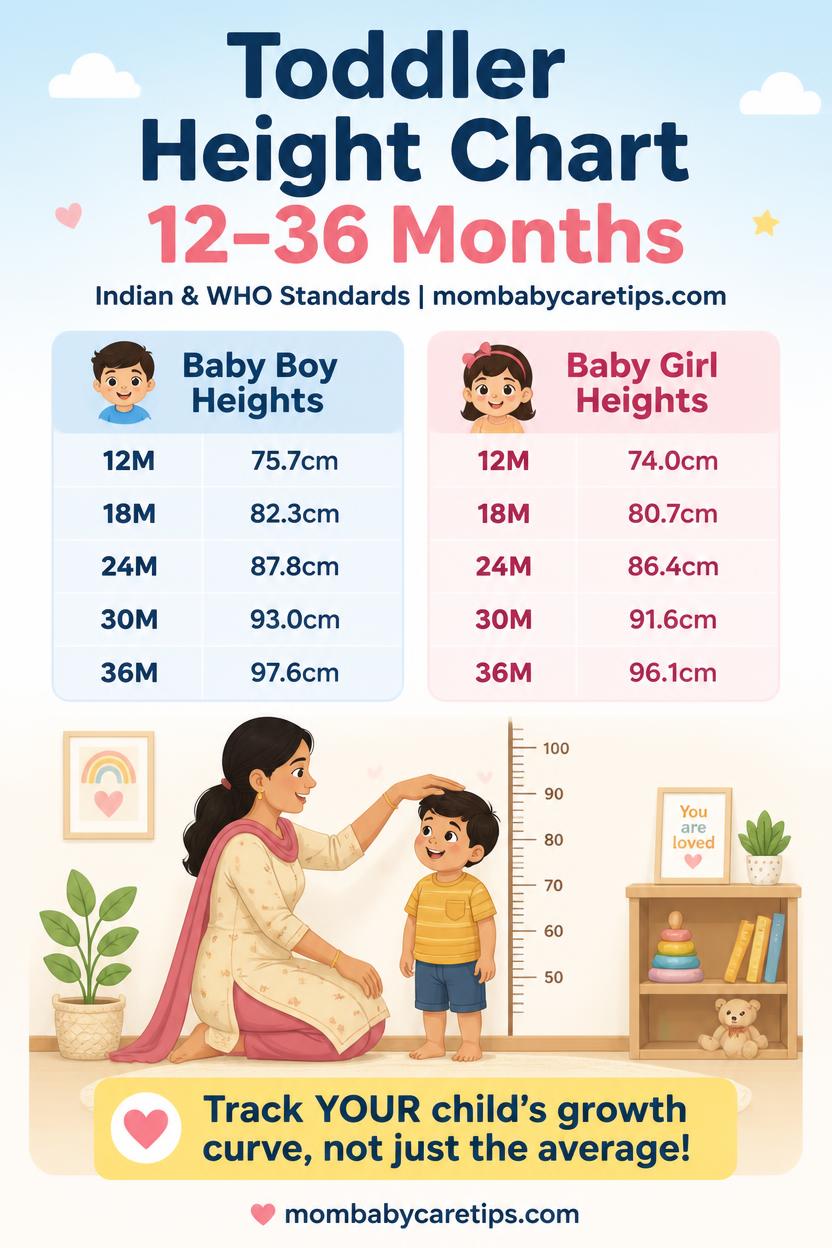
Toddler Boy Height Chart (12–36 Months) — WHO Standards
The table below shows average height for baby boys from 12 to 36 months based on WHO Child Growth Standards. The “Average” column represents the 50th percentile. The normal range covers the 3rd to 97th percentile — healthy children fall anywhere within this band.
| Age | Average Height (cm) | Normal Range (cm) | Approx. in Inches |
|---|---|---|---|
| 12 Months | 75.7 cm | 70.1 – 81.3 cm | ~29.8 in |
| 13 Months | 76.9 cm | 71.3 – 82.6 cm | ~30.3 in |
| 14 Months | 78.0 cm | 72.2 – 83.8 cm | ~30.7 in |
| 15 Months | 79.1 cm | 73.3 – 85.0 cm | ~31.1 in |
| 16 Months | 80.2 cm | 74.4 – 86.1 cm | ~31.6 in |
| 17 Months | 81.2 cm | 75.2 – 87.2 cm | ~32.0 in |
| 18 Months | 82.3 cm | 76.0 – 88.7 cm | ~32.4 in |
| 19 Months | 83.2 cm | 76.9 – 89.7 cm | ~32.8 in |
| 20 Months | 84.2 cm | 77.7 – 90.7 cm | ~33.1 in |
| 21 Months | 85.1 cm | 78.6 – 91.6 cm | ~33.5 in |
| 22 Months | 86.0 cm | 79.4 – 92.5 cm | ~33.9 in |
| 23 Months | 86.9 cm | 80.1 – 93.3 cm | ~34.2 in |
| 24 Months | 87.8 cm | 81.0 – 94.4 cm | ~34.6 in |
| 25 Months | 88.8 cm | 81.8 – 95.5 cm | ~35.0 in |
| 26 Months | 89.7 cm | 82.6 – 96.4 cm | ~35.3 in |
| 27 Months | 90.5 cm | 83.4 – 97.2 cm | ~35.6 in |
| 28 Months | 91.4 cm | 84.1 – 98.1 cm | ~36.0 in |
| 29 Months | 92.2 cm | 84.9 – 99.0 cm | ~36.3 in |
| 30 Months | 93.0 cm | 85.6 – 99.8 cm | ~36.6 in |
| 31 Months | 93.8 cm | 86.4 – 100.7 cm | ~36.9 in |
| 32 Months | 94.6 cm | 87.1 – 101.5 cm | ~37.2 in |
| 33 Months | 95.4 cm | 87.7 – 102.3 cm | ~37.6 in |
| 34 Months | 96.1 cm | 88.5 – 103.0 cm | ~37.8 in |
| 35 Months | 96.9 cm | 89.2 – 103.8 cm | ~38.1 in |
| 36 Months | 97.6 cm | 90.0 – 104.5 cm | ~38.4 in |
Source: WHO Child Growth Standards — Length/Height-for-Age (2006). Normal range represents the 3rd–97th percentile band.
Toddler Girl Height Chart (12–36 Months) — WHO Standards
Girls typically measure slightly shorter than boys at the same age during the toddler years, though the difference is modest. Both follow healthy growth patterns when they consistently track on their own curve over time.
| Age | Average Height (cm) | Normal Range (cm) | Approx. in Inches |
|---|---|---|---|
| 12 Months | 74.0 cm | 68.9 – 79.2 cm | ~29.1 in |
| 13 Months | 75.2 cm | 69.8 – 80.5 cm | ~29.6 in |
| 14 Months | 76.4 cm | 70.8 – 82.0 cm | ~30.1 in |
| 15 Months | 77.5 cm | 71.9 – 83.2 cm | ~30.5 in |
| 16 Months | 78.6 cm | 72.9 – 84.3 cm | ~30.9 in |
| 17 Months | 79.7 cm | 73.9 – 85.4 cm | ~31.4 in |
| 18 Months | 80.7 cm | 74.9 – 86.4 cm | ~31.8 in |
| 19 Months | 81.7 cm | 75.7 – 87.5 cm | ~32.2 in |
| 20 Months | 82.7 cm | 76.7 – 88.5 cm | ~32.6 in |
| 21 Months | 83.7 cm | 77.5 – 89.5 cm | ~32.9 in |
| 22 Months | 84.6 cm | 78.4 – 90.5 cm | ~33.3 in |
| 23 Months | 85.5 cm | 79.2 – 91.4 cm | ~33.7 in |
| 24 Months | 86.4 cm | 80.0 – 92.2 cm | ~34.0 in |
| 25 Months | 87.4 cm | 81.0 – 93.2 cm | ~34.4 in |
| 26 Months | 88.3 cm | 81.8 – 94.1 cm | ~34.8 in |
| 27 Months | 89.1 cm | 82.6 – 95.0 cm | ~35.1 in |
| 28 Months | 90.0 cm | 83.3 – 95.9 cm | ~35.4 in |
| 29 Months | 90.8 cm | 84.1 – 96.8 cm | ~35.7 in |
| 30 Months | 91.6 cm | 84.9 – 97.7 cm | ~36.1 in |
| 31 Months | 92.5 cm | 85.6 – 98.5 cm | ~36.4 in |
| 32 Months | 93.3 cm | 86.3 – 99.4 cm | ~36.7 in |
| 33 Months | 94.1 cm | 87.1 – 100.2 cm | ~37.0 in |
| 34 Months | 94.9 cm | 87.8 – 101.0 cm | ~37.4 in |
| 35 Months | 95.7 cm | 88.4 – 101.9 cm | ~37.7 in |
| 36 Months | 96.1 cm | 89.0 – 102.7 cm | ~37.8 in |
Source: WHO Child Growth Standards — Length/Height-for-Age (2006). Normal range represents the 3rd–97th percentile band.
Do These Standards Apply to Indian Toddlers?
This is one of the first questions Indian parents ask — and it is a completely fair one. The short answer is yes. The Indian Academy of Pediatrics (IAP) officially endorses WHO 2006 Child Growth Standards for all children up to 5 years of age.
The WHO study followed healthy children from six countries across different regions and ethnic backgrounds, all raised under optimal conditions including breastfeeding and adequate nutrition. The finding was clear: when nutritional and health conditions are good, children from diverse backgrounds follow remarkably similar growth patterns in the first five years.
This is why a healthy toddler in Mumbai, Jaipur, or Chennai has essentially the same height growth potential as a child in Brazil or the UK during this period. If your child is consistently falling below the normal range, the first step is always a conversation with your pediatrician — focusing on nutrition, health history, and family patterns, not ethnicity.
(Reference: Khadilkar et al., Indian Pediatrics 2015 — IAP Growth Charts Revised)
Key Height Milestones: What to Expect at Each Stage
At 12–15 Months
Your child has just crossed the one-year mark. Most boys are between 70–85 cm and most girls between 69–83 cm. Walking begins in earnest around this time, and posture changes naturally affect how upright they hold themselves. A 14-month-old boy averaging 78 cm is right on track with the 50th percentile.
If you want to compare this to the first-year growth pattern, our baby height chart for 0–12 months gives you the full picture from birth through the first birthday.
At 18 Months
The 18-month checkup is usually the last one before the 2-year visit. At this point, the average height for boys is around 82.3 cm and for girls around 80.7 cm. Some children are significantly shorter or taller and all are healthy — what matters is that they are following their own consistent growth curve.
At 24 Months
Two years is a significant milestone. Boys average around 87.8 cm and girls around 86.4 cm. If your 2-year-old Indian girl is around 84 cm, that places her in roughly the 20th–30th percentile — well within the normal range. At 24 months, pediatricians also begin measuring standing height instead of lying length, which can result in a very slightly lower reading. This is expected and normal.
At 36 Months
By age 3, boys typically reach about 97–98 cm and girls around 96 cm. Total height gain from 12 to 36 months averages around 20–22 cm — much less than the explosive first year, but steady. For weight tracking alongside this period, the baby weight chart (0–5 years) covers toddler weight benchmarks in the same age range.
What Affects Toddler Height?
Genetics Come First
The single strongest predictor of a child’s height potential is parental height. Pediatricians sometimes use a rough “mid-parental height” calculation to estimate a child’s likely adult height, though it is just an estimate. If both parents are on the shorter side, it is perfectly natural for their toddler to track in the lower height percentiles.
Nutrition Supports Growth — But Isn’t a Direct Switch
Good nutrition is essential, but it supports growth potential rather than guaranteeing it. For toddlers, adequate protein, calcium, vitamin D, and overall calorie intake matter. Extra supplements or larger portions in a child who is already growing well will not make them taller — it will mostly just affect weight.
If your toddler is a picky eater or you are working on improving their diet, our guide on weight gain foods for babies covers many nutrient-dense Indian options that work well into the toddler years too — think ragi porridge, daal khichdi, ghee, and paneer.
Sleep Is When the Growing Happens
Growth hormone is released primarily during deep sleep. Toddlers generally need about 11–14 hours of sleep per day including naps, according to guidelines from the American Academy of Sleep Medicine. Chronic severe sleep disruption has been linked to slower growth patterns in research, though this refers to consistent long-term disruption — not the occasional rough night every parent knows well.
(Source: American Academy of Sleep Medicine — Pediatric Sleep Duration Consensus)
General Health
Frequent illness, chronic infections, or certain underlying conditions can affect growth over time. Most toddlers who fall ill occasionally catch up without issue. Persistent illness combined with stalled growth is worth discussing with your doctor.
When Should You Talk to a Pediatrician?
Most parents do not need to worry if their toddler tracks in the lower percentile range. A toddler in the 10th percentile can be perfectly healthy. That said, it is worth a conversation with your doctor if:
- Your child’s height has dropped across two or more major percentile lines over several months
- Growth appears to have completely stalled — no measurable increase over 4–6 months
- Short stature is combined with other concerns like fatigue, poor appetite, or missed developmental milestones
- There is a family history of growth hormone deficiency or thyroid conditions
In most cases, a pediatrician will simply monitor the trend over 3–6 months before recommending any investigation. Referrals for further tests are usually reserved for situations where stalling growth appears alongside other clinical signs.
A Quick Note on Measuring Toddlers at Home
Measuring a toddler who refuses to stand still is genuinely tricky. Here is the simplest method:
- Stand your child against a smooth wall, feet flat and heels touching the wall
- They should be looking straight ahead, not tilting their chin up or down
- Place a flat book or ruler horizontally on top of their head, touching the wall
- Mark the spot with a pencil, then measure from the floor to the mark
If your home reading is slightly different from the clinic’s, it is usually a measurement difference — pediatric nurses use calibrated stadiometers that are more accurate than home setups. The clinic reading is always the one to use for tracking.
Frequently Asked Questions
What is the average height of a 14-month-old baby boy?
According to WHO growth standards, the average height for a 14-month-old boy is approximately 78 cm (about 30.7 inches). The normal healthy range runs from roughly 72 to 84 cm at this age.
Is 84 cm normal for a 2-year-old Indian girl?
Yes, 84 cm is within the normal healthy range for a 2-year-old girl. The WHO average at 24 months is 86.4 cm, with a range of approximately 80–92 cm. A 2-year-old girl at 84 cm is in roughly the 20th–30th percentile — healthy, just on the shorter side of average.
What should be the ideal height of an 18-month Indian baby?
At 18 months, the WHO average height is 82.3 cm for boys and 80.7 cm for girls. The normal range is roughly 76–89 cm for boys and 75–86 cm for girls. The Indian Academy of Pediatrics endorses the same WHO standards for Indian toddlers under 5.
How much height does a toddler gain between 1 and 3 years?
On average, toddlers gain about 12–13 cm per year between ages 1 and 3. Most go from approximately 75–76 cm at 12 months to around 97–98 cm by 36 months.
My toddler is shorter than all children at daycare. Should I worry?
Not necessarily. Children of the same age can differ by 10 cm or more in height and all be completely healthy. The more meaningful question is whether your child has been consistently following their own growth curve over time. If their percentile has remained stable and they are active, eating, and developing normally, there is usually no concern. Bring it up at your next checkup if you are unsure.
Do Indian toddlers follow different growth charts than Western children?
No. The Indian Academy of Pediatrics (IAP) recommends WHO 2006 growth standards for all children from birth to 5 years. The WHO research found that children from different backgrounds reach similar height and weight milestones in early childhood when nutrition and health conditions are adequate.
SOURCES
────────────────────────────────────────────────────────────────── –>

Comments
Be the first to leave a comment!