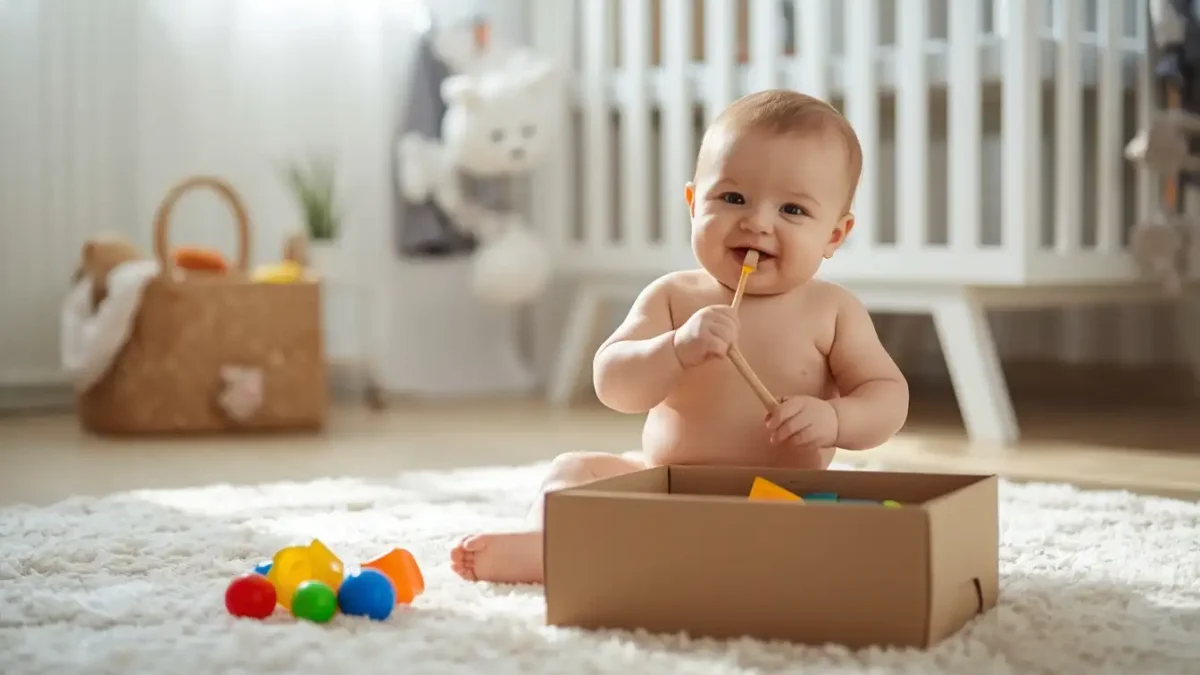
You spend hours researching the best developmental toys. You finally buy that bright, highly-rated activity cube, place it in front of your six-month-old, and wait for the magic to happen. Instead, they stare at it for two seconds, grab the cardboard box it came in, and spend the next twenty minutes chewing on a flap.
If you find yourself wondering, “Why doesn’t my baby play with toys?”, you are definitely not alone. It is a incredibly common scenario in nurseries everywhere. When you are tired and just looking for five minutes to drink a warm cup of coffee, seeing your baby completely ignore a basket full of expensive toys can be frustrating.
The truth is, a baby’s lack of interest in traditional toys rarely means something is wrong. Their brains are processing the world differently than ours do. What looks like a boring set of measuring cups to us might be the most fascinating sensory experience in the room for an infant.
This guide will break down why babies often reject toys, how their developmental stages affect what they find interesting, and practical ways to encourage independent play without feeling stressed.
Table of Contents
Why Do Babies Not Like to Play with Their Toys But Play with Everything Else?
It is one of the oldest jokes in parenting: buy a toy, and the baby will play with the box. But there is actual developmental science behind this behavior. When you search online asking, “why do babies not like to play with their toys but play with everything else,” the answer usually comes down to sensory feedback.
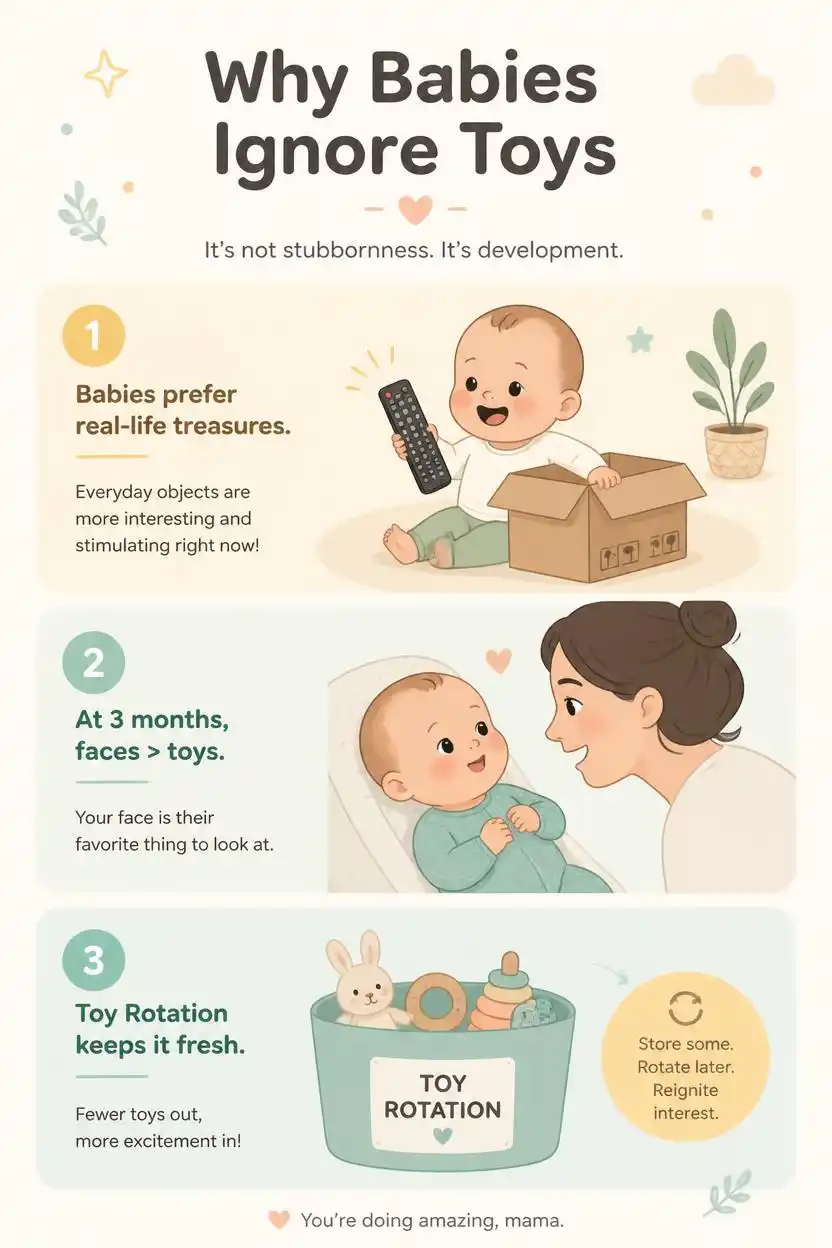
Toys are designed to be safe, smooth, and predictable. Household objects are not. To a growing baby, a set of metal keys makes a sharp, fascinating jingle that a plastic rattle simply cannot replicate. A crinkly empty wipes packet offers incredible tactile feedback and a satisfying sound. A TV remote has small, rubbery buttons that are perfect for curious little fingers.
Babies are little scientists. They do not know what a “toy” is supposed to be. They only know what provides the best sensory reaction when they drop it, bang it, or chew on it. Everyday items often provide more complex textures, weights, and sounds than standard baby toys, which is exactly why they are so drawn to them.
How Age and Development Affect Toy Interest
Before you worry that your baby dislikes playing, it helps to look at what they are physically capable of doing at their current age. Play looks very different at three months than it does at nine months.
0–3 Months: The Observer Stage
Newborns simply lack the motor skills to grasp and manipulate objects. At this stage, their primary “toy” is your face. They are working on visual tracking and auditory recognition. If you shake a rattle and they look away, they aren’t bored—they might just be overstimulated. Sometimes, just letting them watch you from a safe spot is all the stimulation they need (if you need a seat for this, checking the difference between baby rocker and baby bouncer is a helpful start).
4–6 Months: The Mouthing Stage
Around this age, babies discover their hands and realize they can bring things to their mouths. Mouthing is a crucial developmental milestone. They have more nerve endings in their mouths than in their hands, so chewing on a block is actually how they learn about its shape and texture. If they are just chewing on toys rather than “playing” with them, they are actually doing exactly what they should be. This is the perfect age to introduce varied textures, which is exactly why experts suggest that sensory toys are highly beneficial for babies.
7–12 Months: Cause and Effect
This is when object permanence develops—the understanding that an object still exists even when they can’t see it. This is the age of dropping spoons from the highchair just to watch you pick them up. They love hitting things together to hear the noise. Traditional toys might be ignored in favor of pots and wooden spoons because kitchen items make better sounds.
“My Baby is Not Interested in Toys” – Is This Normal?
It is very common to hear a parent say, “my baby is not interested in toys at all.” In the vast majority of cases, this is completely normal. Every child has a unique temperament and sensory profile.
Some babies are highly active. They would rather pull up on furniture, practice crawling, or empty lower cabinets than sit still with a shape sorter. Their current developmental priority is gross motor movement (using large muscles), not fine motor skills (using small hand muscles).
Other babies are observers. They might prefer to sit quietly and watch a ceiling fan spin or study the way light filters through a curtain. As long as your baby is alert, engaging with you through eye contact and smiles, and meeting their basic physical milestones, a lack of interest in traditional toys is usually just a matter of personal preference.
Autism and Toy Play: When to Pay Attention
While ignoring toys is usually normal, parents sometimes wonder if it could be a sign of something else, like autism spectrum disorder (ASD). Children with autism often interact with the world and objects differently.
Rather than engaging in imaginative or functional play (like pushing a toy car across the floor), a child with autism might focus intensely on a single part of the toy—like repeatedly spinning the wheels of the car for long periods. They might also prefer to line toys up in strict rows rather than play with them, and become highly distressed if the line is disrupted.
The key difference lies in social engagement. If a baby ignores toys but still makes strong eye contact, babbles at you, and points to show you things across the room, they are showing healthy social development. If they are consistently ignoring both toys AND social interactions (not responding to their name, avoiding eye contact), it is a good idea to bring it up gently with your pediatrician.
What to Do If Baby is Not Interested in Toys
If you are struggling to keep your little one occupied and frequently searching for “what to do if baby not interested in toys,” there are several practical strategies you can try at home.
1. Try Toy Rotation
When a baby is presented with a massive bin of twenty toys, they often experience decision fatigue. They will dump the bin out and walk away. Instead, pack away most of their toys in a closet. Leave only three or four distinct toys out on a shelf. Every week or two, swap them out. Toys they ignored last month suddenly become exciting and new when they haven’t seen them in a while. As they get slightly older, rotating in familiar character items (like checking what is best Blippi toys for babies) can also instantly re-engage their attention.
2. Get on the Floor and Demonstrate
Babies learn by imitation. If a toy is just sitting on the rug, it might look boring. But if you sit down, pick up the stacking rings, and exaggeratedly act surprised when you pull one off, they will likely crawl over to investigate. You have to show them how the toy works.
3. Create “Safe” Household Toy Bins
If your baby prefers real items, lean into it safely. Create a bottom kitchen drawer or a small basket filled with baby-safe household items: a silicone whisk, some plastic measuring cups, a clean wooden spoon, and a small metal bowl. Let them explore these items while you cook. It satisfies their urge for real-world textures while keeping them safe.
Quick Guide: Matching Toys to Developmental Needs
Sometimes a baby rejects a toy simply because it is too advanced or too simple for their current brain stage. Here is a quick reference table to help you match the right toy type to your baby.
| Age Range | What Their Brain is Doing | Best Toy Types to Try |
|---|---|---|
| 0–3 Months | Developing vision and focus. | High-contrast (black and white) cards, unbreakable mirrors, soft rattles. |
| 4–6 Months | Reaching, grasping, and mouthing. | Textured teethers, crinkle fabrics, O-ball toys that are easy to grab. |
| 7–9 Months | Understanding object permanence. | Nesting cups, simple pop-up toys, balls they can roll. |
| 10–12+ Months | Cause and effect, gross motor skills. | Stacking blocks, push-walkers, simple shape sorters. |
If you’re looking to explore age-appropriate, durable options that are safe for mouthing, a simple set of wooden baby toys is one option that comes up often for encouraging natural, quiet play.
Frequently Asked Questions
Is it normal for a 6-month-old to not play with toys?
Yes, absolutely. At six months, a baby is heavily focused on learning how their own body works (rolling, trying to sit up) and mouthing objects to understand textures. They might not use toys for their intended purpose yet, and that is perfectly healthy.
Why does my baby only want to play with the TV remote or my phone?
Babies observe you closely. They see that you pay a lot of attention to your phone and the remote, so they naturally assume these objects are highly valuable. Furthermore, remotes have interesting rubber buttons that feel great on teething gums.
How many toys should a baby have out at once?
Less is usually more. Pediatric occupational therapists often recommend keeping only 4 to 6 toys out in a play area at any given time. This prevents visual clutter and encourages deeper, more focused play with the items that are available.
Conclusion
Parenting involves a lot of second-guessing, especially when your baby doesn’t seem to follow the “rules” of what a baby should enjoy. If your little one prefers a cardboard box to a musical light-up station, embrace it.
Babies play with toys differently than older children because they are still establishing the basic physical laws of their environment. By keeping their play space simple, understanding their sensory needs, and leaning into their natural curiosities, you can support their development without stressing over a lack of interest in plastic toys. Let them explore safely, and their play behavior will naturally evolve as they grow.
Comments
Be the first to leave a comment!