
Toddler Boy Weight Chart (12 to 36 Months): Indian Growth Reference
As baby boys grow past their first birthday, their weight gain begins to stabilize. After a year of rapid growth, toddlers start burning calories at a faster rate as they learn to walk, run, and actively explore their surroundings. During this phase, many parents notice their child’s appetite drop and worry that their toddler is not gaining enough weight.
To help you track your child’s physical development, this guide provides a complete boy baby weight chart in kg, covering month-by-month ranges for toddler boys aged 12 to 36 months (extending up to 5 years). These guidelines are based on the WHO Child Growth Standards, which are endorsed by the Indian Academy of Pediatrics (IAP).
If you are tracking a younger infant, you can refer to our Indian baby weight chart by month (0–12 months). For height milestones, check out our dedicated toddler height chart (12–36 months).
Table of Contents
1. Understanding Toddler Boy Growth Velocity
Toddlerhood is characterized by steady physical maturation and high physical activity. Unlike the infancy phase, when weight can double or triple in months, toddlers typically gain about 1.5 to 2.5 kg over the course of a year. Because active play burns calories rapidly, boys will naturally lose their soft baby appearance and look leaner. This physical change is normal and does not mean your child is underweight.
Every toddler has a unique growth curve determined by genetics, daily nutrition, and physical build. Instead of aiming for a specific percentile on a chart, the goal is for your child to grow consistently along their own established percentile curve. For boys born prematurely, remember that their early weight tracking should use the corrected age timeline, as explained in our premature baby boy weight guide.
2. Toddler Boy Weight Chart (12–36 Months) in Kg
The table below details the median (50th percentile) weight and the normal weight range (3rd to 97th percentile) for toddler boys from 12 to 36 months, based on WHO standards. If your boy falls within the 3rd to 97th percentile, his weight is considered medically normal.
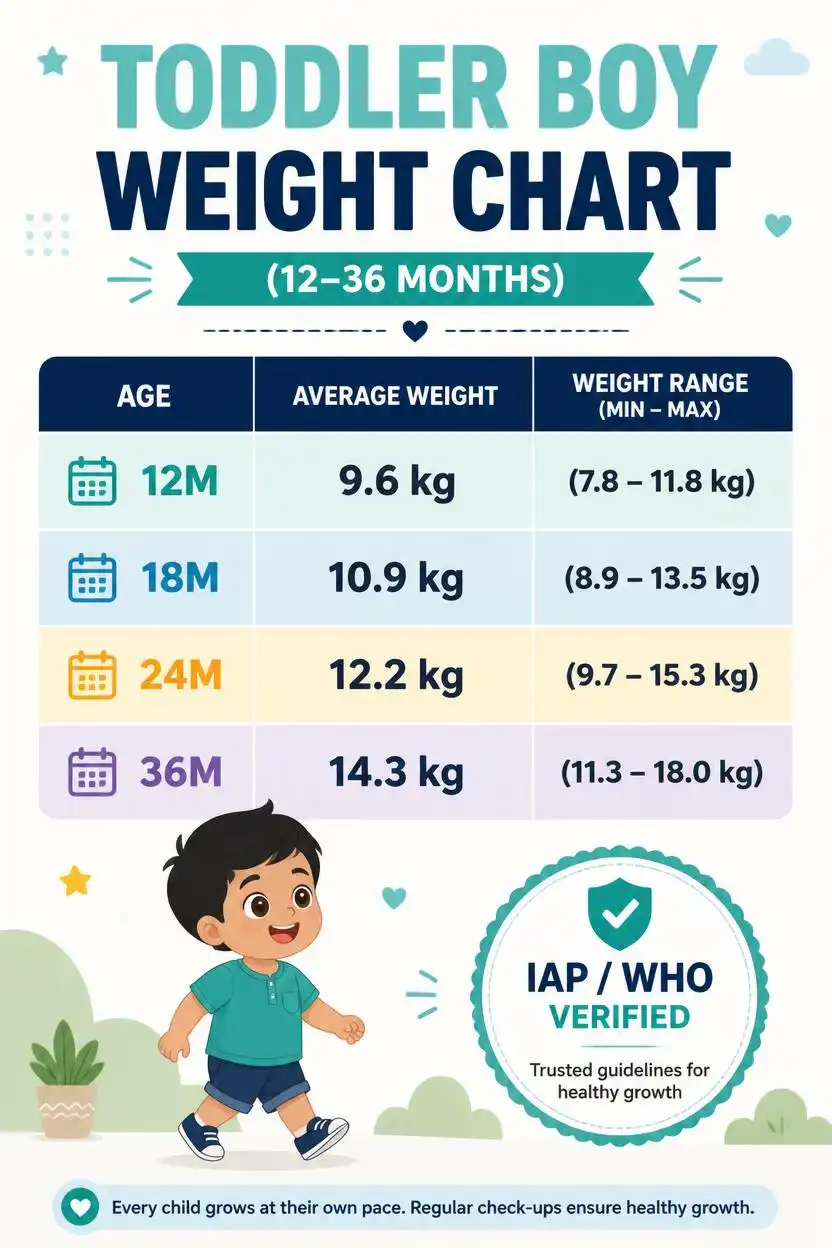
| Age (Months / Years) | Average Weight (50th %) | Normal Weight Range (Kg) | Expected Gain (Approx.) |
|---|---|---|---|
| 12 Months (1 Year) | 9.6 kg | 7.8 – 11.8 kg | ~180g – 220g per month |
| 15 Months | 10.3 kg | 8.4 – 12.7 kg | |
| 18 Months (1.5 Years) | 10.9 kg | 8.9 – 13.5 kg | |
| 21 Months | 11.5 kg | 9.4 – 14.3 kg | |
| 24 Months (2 Years) | 12.2 kg | 9.7 – 15.3 kg | ~130g – 160g per month |
| 27 Months | 12.7 kg | 10.1 – 15.9 kg | |
| 30 Months (2.5 Years) | 13.3 kg | 10.5 – 16.6 kg | |
| 33 Months | 13.8 kg | 10.9 – 17.2 kg | |
| 36 Months (3 Years) | 14.3 kg | 11.3 – 18.0 kg | Stabilized growth velocity |
Looking for Girls’ weight ranges instead? We have a dedicated, month-by-month guide covering the healthy growth parameters and percentile charts for toddler girls. Read our full 2 Year Old Baby Girl Weight in Kg Chart.
3. Older Toddler Boy Weight (3 to 5 Years)
For parents tracking growth as their child transitions from toddlerhood into preschool years, weight progression remains slow and consistent. Pediatricians evaluate these ranges to monitor for both nutritional deficiencies and pediatric obesity. The average weight parameters for boys from 3 to 5 years include:
- 3.5 Years (42 Months): Boys average 15.3 kg, with a normal range between 12.0 kg and 19.3 kg.
- 4 Years (48 Months): Boys average 16.3 kg, with a normal range between 12.7 kg and 20.7 kg.
- 5 Years (60 Months): Boys average 18.3 kg, with a normal range between 14.1 kg and 23.8 kg.
These values can be cross-referenced with standard measurements found in our general baby weight chart, which outlines global child development baselines.
4. Why Toddler Boy Weight Gain Slows Down
It is common for parents to observe a sharp decline in their toddler’s appetite around 15 to 18 months. This shift is a normal developmental phase and is driven by two main factors:
Physiological Growth Deceleration
If children continued to grow at their infant rate, a 3-year-old would weigh as much as an adult. Biologically, their rate of growth slows down significantly after 12 months. Since their body does not require the same massive caloric influx relative to their size, their hunger signals decrease naturally, resulting in a lower appetite.
Increased Physical Energy Expenditure
Toddlers are constantly on the move. They walk, climb, run, and engage in continuous active play. This active lifestyle burns off calories rapidly. If you are concerned about supporting their nutritional needs with healthy, calorie-dense foods, our baby weight gain foods guide covers nutrient-dense options like ghee, ragi, and curd that are ideal for active children.
5. Common Parental Queries about Boy Weight
Parents often seek advice about specific weight milestones. Here are some common situations evaluated using the WHO standard datasets:
Is 12 kg a normal weight for a 23-month-old Indian boy?
Yes. The WHO median weight for a 23-month-old boy is approximately 12.0 kg. A boy weighing 12 kg at this stage is right on the 50th percentile, indicating excellent, healthy development.
My 19-month-old (1.7 years) baby boy weighs 8.2 kg. Is this healthy?
At 19 months, the lower boundary of the normal weight range (3rd percentile) for boys is 9.1 kg. A weight of 8.2 kg is below this threshold, indicating that the child is underweight. We recommend consulting a pediatrician to evaluate his growth and adjust his diet.
What is the average weight for a boy at 2.8 years (34 months)?
At 34 months, the average (median) weight for a boy is 14.0 kg. The normal range spans from 11.0 kg to 17.5 kg. A boy weighing 13 kg at this age is completely healthy.
Can a 17-month-old boy weigh 25 kg?
No. The normal weight for a 17-month-old boy averages 10.7 kg, with the maximum normal range (97th percentile) sitting around 13.3 kg. A weight of 25 kg is double the expected weight for this age and is almost certainly a typing error (for example, meaning 12.5 kg). If the weight is accurate, immediate medical attention is required.
6. When to Consult a Pediatrician
While minor growth fluctuations are normal, certain signs warrant a medical evaluation by a pediatrician:
- Your toddler’s weight drops across two or more major percentile lines on his growth chart.
- He does not gain any weight for three consecutive months.
- He shows persistent lethargy, poor concentration, or frequently falls ill.
- His weight falls below the 3rd percentile or exceeds the 97th percentile.
For younger infants, tracking early milestones like wet diaper frequency and initial weight recovery can be found in our newborn baby weight guide. If you need to manage your toddler’s diet without dairy products, our toddler weight gain foods without milk guide outlines healthy dairy-free options.
7. Frequently Asked Questions
What is the average weight of a 2-year-old boy in kg?
According to the WHO Child Growth Standards, the average (median) weight of a 2-year-old (24 months) boy is 12.2 kg. The healthy normal range at this age falls between 9.7 kg and 15.3 kg.
What is the normal weight range for a 1.5-year-old boy in kg?
At 18 months (1.5 years), the normal weight range for a baby boy is 8.9 kg to 13.5 kg, with the average median weight sitting at 10.9 kg.
How much weight does a toddler boy gain per month on average?
Between 1 and 2 years of age, a toddler boy gains about 180 to 220 grams per month. Between 2 and 3 years, this slows further to about 130 to 160 grams per month.
Why is my toddler boy looking thinner even though he is active?
This is a normal change. Once toddlers start walking and running, they burn off their baby fat and build muscle. If he is active, meeting milestones, and tracking along his weight curve, this leaner appearance is completely healthy.
Medical Disclaimer: The weight standards in this article are based on WHO Child Growth Standards (2006) and are meant for educational reference only. Individual growth curves vary based on genetics and health history. This content is not a substitute for professional clinical advice. Always consult your pediatrician regarding your child’s growth and development.
Sources & References
- WHO Child Growth Standards — Weight-for-Age (2006)
- Khadilkar et al., Indian Pediatrics 2015 — IAP Growth Charts Reference
- Pediatric Growth Assessment Parameters — StatPearls (NCBI)

Comments
Be the first to leave a comment!