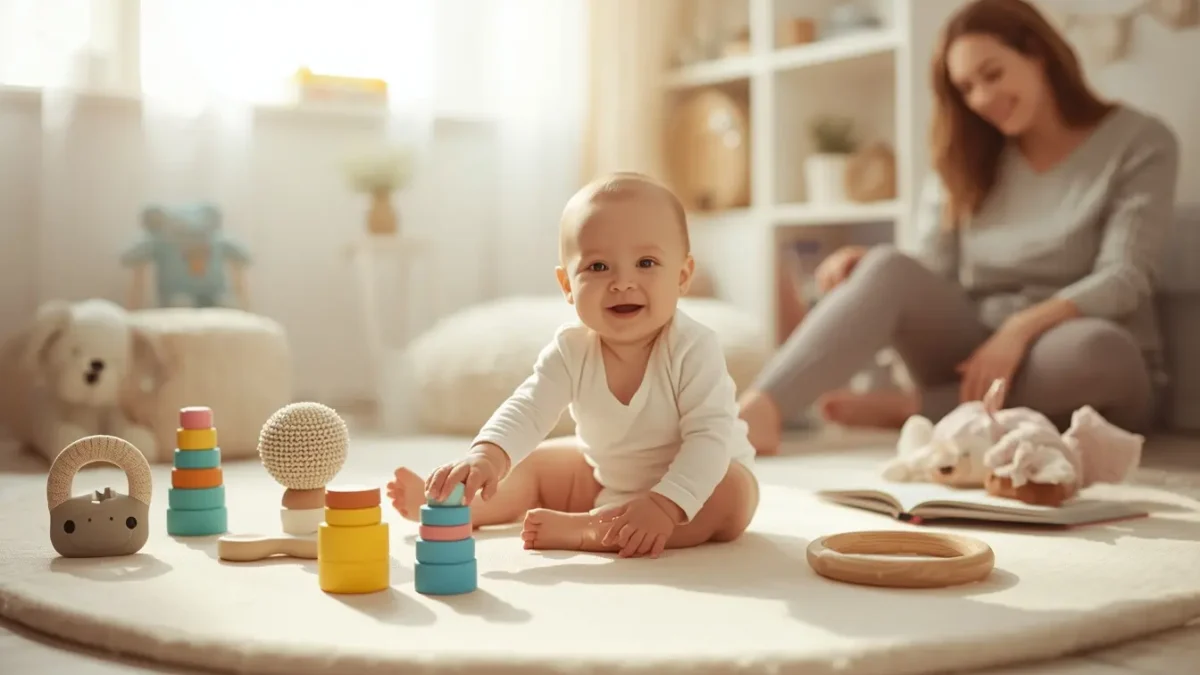
Six months is a funny age. Your baby is suddenly awake more, curious about everything, and not quite happy just lying on their back anymore. They want to do something. They want to grab, chew, shake, and explore — and as a parent, you’re probably wondering what on earth to actually give them that’s useful and safe.
The toy aisle can feel overwhelming. Bright boxes with bold claims, expensive sets that promise to make your baby smarter — it’s a lot. The honest truth? Six-month-olds don’t need much. What they need are things that match where they actually are developmentally right now.
Here’s a simple, practical guide to the kinds of toys that genuinely work well at this age — and a few things worth skipping.
What’s Actually Happening at 6 Months?
Before jumping to the list, it helps to know what your baby is working on right now. Around six months, most babies are starting to sit with some support, reaching and grasping intentionally, bringing everything to their mouth, and responding to sounds and faces with real interest.
They’re also learning cause and effect for the first time — the idea that “I do this, and that happens.” Shake a rattle, it makes a sound. Hit a button, a light blinks. This is genuinely exciting for them, and the right toys support exactly this kind of learning.
If you’re tracking your baby’s development, a baby milestone tracker can help you see what skills are typically emerging at each stage — useful to have alongside any toy shopping decisions.
Types of Toys That Work Well for 6-Month-Olds
1. Soft Rattles and Shaker Toys
Simple rattles are classic for a reason. They’re lightweight enough for small hands to hold, they make an immediate sound when moved, and that instant feedback is exactly what six-month-olds respond to. Look for ones with a comfortable grip size, nothing too heavy or too bulky.
Fabric rattles are a particularly good choice at this age because they’re soft when babies inevitably bonk themselves in the face — which they will.
2. Textured Teething Rings and Sensory Toys
At six months, teething often starts picking up, and babies want to mouth absolutely everything. Textured teething rings serve double duty — they’re satisfying to chew and the different textures on them also give babies something to explore with their fingers.
Sensory toys for 6 month olds are really just anything with varied textures, colours, or sounds. A crinkly fabric toy, a soft book with different surfaces, a ring with bumps and ridges — these all count. You don’t need anything fancy.
3. Soft Activity Gyms and Play Mats
If you don’t already have one, a simple play gym is worth considering at this stage. Hanging toys that babies can bat at and eventually grab are great for developing hand-eye coordination. They also encourage babies to spend time on their tummy or back in a stimulating environment.
You don’t need one with forty attachments. Even a simple arch with three or four things to look at and touch does the job well.
4. Cause-and-Effect Toys
These are the toys where the baby does something — presses, shakes, squeezes — and something happens in response. A ball that plays a short sound when rolled, a soft toy that makes a noise when squeezed, a simple light-up item triggered by touch.
Cause and effect toys for babies at this age don’t need to be complex. The simpler the connection between action and response, the better babies can actually understand what’s happening.
5. Stacking Cups and Soft Blocks
These seem simple — and they are — but babies at six months love to grab, hold, mouth, and eventually bang things together. Soft blocks or lightweight stacking cups give them something to manipulate with both hands. Banging two blocks together is genuinely satisfying at this age.
They won’t stack them for a while yet, but holding, passing from hand to hand, and exploring the shapes is all useful play right now.
6. Board Books
Books at six months look nothing like story time at age three. Babies at this stage mostly want to look at high-contrast images, touch the pages, and chew the corners. Board books with simple, clear pictures — especially faces — hold their attention well.
Reading to babies at this age is genuinely useful for language development, even if they’re more interested in the texture of the page than the words. Short, simple, and repeated is fine.
7. Household Items (Yes, Really)
One of the more common questions parents ask is whether household items are safe as toys for babies. The honest answer is: some of them, absolutely. Babies are genuinely entertained by wooden spoons, metal bowls they can bang, plastic containers in different sizes, and similar items.
The main things to check: no sharp edges, nothing small enough to be a choking hazard, nothing that could shatter, and nothing with paint or coatings that could flake off. A set of measuring cups or a clean plastic colander can keep a six-month-old happily occupied for a while, and there’s nothing wrong with that at all.
A Note on Wooden Toys
Wooden toys are popular right now, and for good reason — they tend to be durable, free of certain plastics, and often simpler in design. If you’re considering them, soft-edged wooden rattles or simple wooden rings can work well at six months. If you’re curious about what wooden options are typically recommended for babies, we’ve covered that separately in our guide to wooden baby toys.
Should You Buy Electronic Educational Toys?
This question comes up a lot, and it’s worth being straightforward about it. There’s no strong evidence that electronic educational toys give babies a developmental advantage over simpler toys at this age. Many pediatric experts suggest that open-ended play — where the baby controls what happens — is more valuable than passive entertainment from a toy that does everything automatically.
That said, a simple light-up toy or one that plays a short tune isn’t harmful if your baby enjoys it. The concern is more about toys that replace interaction — ones where the toy does all the work while the baby just watches.
The most developmental play at six months still involves you. Talking, making faces, responding to what they do, playing simple games — none of that requires a toy at all.
How Many Toys Does a 6-Month-Old Actually Need?
Less than you think. Having too many toys out at once can actually overwhelm babies and make it harder for them to focus on any one thing. A few good options that get rotated every week or so tends to work much better than a pile of everything at once.
Three to five toys available at any given time is plenty. If you have more, put some away and swap them out every week or two. Babies often respond to a “new” toy that’s actually something they had before — the break makes it interesting again.
Keeping Toys Clean and Safe
Since six-month-olds mouth everything, toy hygiene matters more than at most other ages. Fabric toys in particular need regular washing. If you’re not sure how to clean fabric baby toys safely without damaging them, it’s worth checking — some can go in the washing machine, others are better wiped down. We’ve written a practical guide on how to clean fabric baby toys if that’s useful.
For hard plastic or wooden toys, a simple wipe with a damp cloth and mild baby-safe cleaner works well. Let them dry fully before giving them back.
The Best Way to Play With a 6-Month-Old
This sounds obvious, but the toy itself matters less than what you do with it. Getting down on the floor with them, narrating what you’re doing, making silly sounds, responding when they grab something or look at you — that kind of interaction is what actually drives development at this age.
You can use any toy on this list, or no toy at all, and have a genuinely good play session. At six months, your presence and responsiveness is the most valuable thing.
FAQ
What kind of toys should a 6-month-old play with?
Soft rattles, textured teething toys, simple cause-and-effect toys, soft blocks, and board books are all well-suited to this age. The key is toys they can hold, manipulate, and explore — not ones that entertain them passively.
How many toys does a 6-month-old need?
Not many. Three to five toys available at once is enough. Rotating them every week or two keeps things fresh without overloading your baby — or your living room.
Are household items safe as toys for babies?
Some of them, yes. Wooden spoons, clean plastic containers, and metal bowls can all work well as improvised toys. Just check for sharp edges, loose parts, flaking surfaces, or anything small enough to be a choking risk.
Should I buy electronic educational toys for my 6-month-old?
It’s not necessary, and some research suggests simpler toys support more active engagement. A basic cause-and-effect toy with lights or sounds is fine occasionally, but it shouldn’t replace interactive play with you.
How do I know if a toy is safe for my baby?
Check that it has no small parts (nothing smaller than a 50-paisa coin), no sharp edges, no loose strings or ribbons longer than about 15 cm, and that any paint or coating is non-toxic. For branded toys, look for BIS (Bureau of Indian Standards) certification if buying in India.
What is the best way to play with a 6-month-old?
Get down to their level, talk to them, respond to what they do, and keep sessions relatively short — fifteen to twenty minutes of focused play is often enough before they need a break. The toy you use matters much less than being present and engaged.
Comments
Be the first to leave a comment!