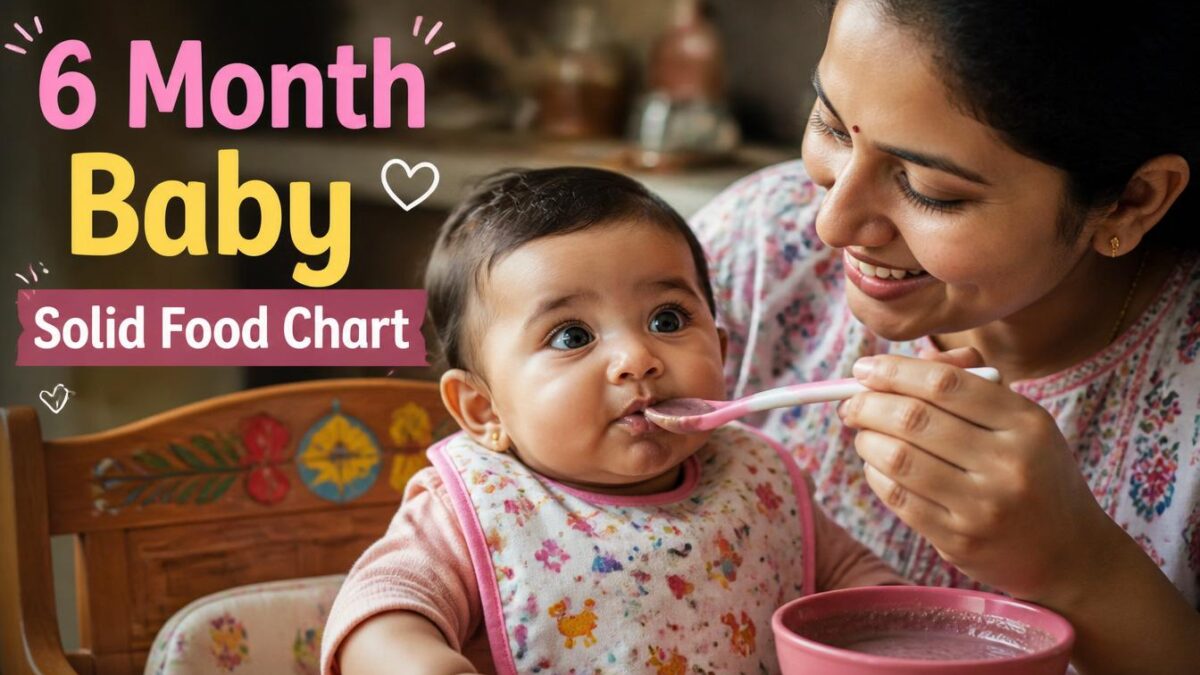
Starting solids is one of those milestones that feels exciting and overwhelming at the same time. You’re ready to introduce your baby to real food — but the questions pile up fast. What do I start with? How much is too much? Is my baby even ready?
If you’re an Indian parent navigating this stage, the confusion is even more real — because the advice from your pediatrician, your mother-in-law, and a random parenting group rarely agrees. This guide cuts through the noise and gives you a practical, week-by-week 6 month baby food chart for Indian babies — based on what actually works, not just what looks good on paper.
Is Your Baby Ready for Solids? Signs to Watch For
Before jumping into a food chart, it’s worth knowing that the “6 months” mark is a general guideline — not a strict start date. Every baby develops differently, and the real signals to watch for are:
- Baby can sit with minimal support and hold their head steady
- They show curiosity when you eat — watching your spoon, reaching for your plate
- The tongue-thrust reflex has reduced (they don’t automatically push food out with their tongue)
- Baby has roughly doubled their birth weight
If your baby is ticking most of these boxes around 6 months, you’re good to start. If not, it’s perfectly fine to wait another week or two. Always loop in your pediatrician before beginning, especially if your baby was premature or has any health concerns.
The One Rule That Makes Everything Easier: The 3-Day Rule
Before getting into the chart itself, this one rule will save you a lot of stress: introduce only one new food every 3 days.
This gives your baby’s gut time to adjust, and more importantly, it helps you spot any food sensitivity or allergic reaction clearly. If you introduce three new foods in one week and your baby develops a rash or loose stools, you won’t know which food caused it. One food at a time keeps things manageable.
6 Month Baby Solid Food Chart — Indian Week-by-Week Guide
This chart is designed for Indian households — using ingredients that are widely available, easy to prepare at home, and gentle on a 6-month-old’s developing digestive system. Start with very thin, smooth consistencies and gradually thicken as your baby gets comfortable.
| Week | Food to Introduce | Consistency | Time of Day |
|---|---|---|---|
| Week 1 | Moong dal water, thin rice kanji, ragi porridge (very thin) | Liquid — like slightly thick water | Morning (after milk feed) |
| Week 2 | Mashed banana, steamed apple puree, pear puree | Very smooth, no lumps | Morning or midday |
| Week 3 | Carrot puree, pumpkin mash, bottle gourd (lauki) puree | Smooth puree, slightly thicker | Morning or afternoon |
| Week 4 | Soft rice-moong dal khichdi (mashed well), ragi with fruit puree | Mashed — slightly textured | Morning or midday |
During this entire first month, breast milk or formula remains your baby’s primary nutrition. These solids are about introducing tastes and textures — not replacing milk feeds. Start with just 1–2 teaspoons per sitting and let your baby lead the pace.
What to Avoid Completely at 6 Months
Indian kitchens are full of wonderful ingredients — but not all of them are ready for a 6-month-old. Keep these off the table for now:
- Salt and sugar — baby’s kidneys are not developed enough to handle added salt; sugar creates unnecessary sugar preferences early on
- Honey — risk of infant botulism before 12 months; this is a firm rule
- Cow’s milk as a main drink — it can be used in cooking in small amounts, but not as a replacement for breast milk or formula before 12 months
- Strong spices — no chilli, heavy masalas, or strong flavours yet
- Whole nuts and hard foods — serious choking risk
A small drop of pure ghee added to khichdi from around the end of the first month is generally considered fine and adds healthy fat — but start minimal and see how your baby responds. Many Indian pediatricians do recommend it in small amounts once the baby has adjusted to solids.
How Much Should a 6 Month Old Eat?
This is one of the most common concerns parents have — and the honest answer is: less than you think. In the first few weeks of starting solids, the quantity barely matters. What matters is getting your baby comfortable with the idea of eating from a spoon.
A rough guide:
- Week 1–2: 1 to 2 teaspoons once a day
- Week 3–4: 2 to 4 teaspoons, once or twice a day
If your baby turns their head away, closes their mouth, or starts fussing — stop. That’s their way of saying they’re done. Never force a feed. Babies are actually quite good at regulating how much they eat when we let them.
A Simple Feeding Schedule for the Day
Here’s what a typical day might look like once your baby is into the second or third week of solids:
| Time | Feed |
|---|---|
| 6:00 – 7:00 AM | Breast milk or formula (main feed) |
| 9:00 – 10:00 AM | Solid food (ragi porridge / fruit puree / dal water) — 2 to 4 tsp |
| 12:00 PM | Breast milk or formula |
| 3:00 PM | Breast milk or formula |
| 6:00 PM (optional) | Small solid feed — vegetable puree or khichdi (Week 3 onwards) |
| Bedtime | Breast milk or formula |
This is just a rough structure. Your baby’s hunger cues and sleep schedule will naturally shape your routine — and that’s fine. Flexibility matters more than a perfect timetable at this stage.
Practical Tips That Actually Help
A few things that make the early solid-feeding phase go smoother:
- Feed solids when your baby is happy and alert — not when they’re overtired or very hungry. A partially fed, calm baby accepts new foods much better.
- Use a small, soft-tipped spoon — it’s gentle on the gums and easier for little mouths to manage.
- Don’t stress over rejection — it can take 10–15 tries before a baby accepts a new flavour. Keep offering without pressure.
- Sit together at mealtimes — babies learn by watching. Eating together, even casually, helps them connect food with something social and positive.
- Make batch portions — steam and puree vegetables in advance, freeze in small ice cube trays. It saves time on busy days.
Frequently Asked Questions
Can I add ghee to my 6 month old’s food?
A very small amount of pure desi ghee — a drop or two — added to khichdi or dal after your baby has been on solids for 2 to 3 weeks is generally considered acceptable by most Indian pediatricians. Ghee provides healthy fats that support brain development. That said, start minimal and skip it if your baby shows any digestive discomfort. When in doubt, your doctor’s guidance takes priority.
My baby keeps pushing the food out — is that normal?
Yes, very much so. In the early weeks, babies often push food out with their tongue — this is partly a reflex and partly just newness. It doesn’t always mean they dislike the food. If your baby seems interested but keeps pushing food out, try waiting another week and then trying again. Some babies just need a little more time.
Do I need to give water when starting solids?
Small sips of cooled, boiled water can be offered from 6 months alongside solids — not instead of milk feeds. There’s no need to push it. Just offer a few sips with the solid meal if you like. Breast milk and formula still cover most of the hydration your baby needs at this stage.
Should I stop breastfeeding now that I’m starting solids?
No. Breast milk or formula continues to be the most important source of nutrition through the entire first year. Solids at 6 months are meant to complement milk — not replace it. Think of early solid feeding as introducing your baby to food, not switching their main source of nourishment.
A Final Word
Starting solids is one of those parenting moments that feels like a bigger deal than it turns out to be. Your baby will go at their own pace, reject some foods a dozen times before accepting them, and make a mess that you will somehow find endearing in retrospect.
Keep it simple. Start slow. Trust the process — and trust your baby. They’re figuring this out too.
Comments
Be the first to leave a comment!