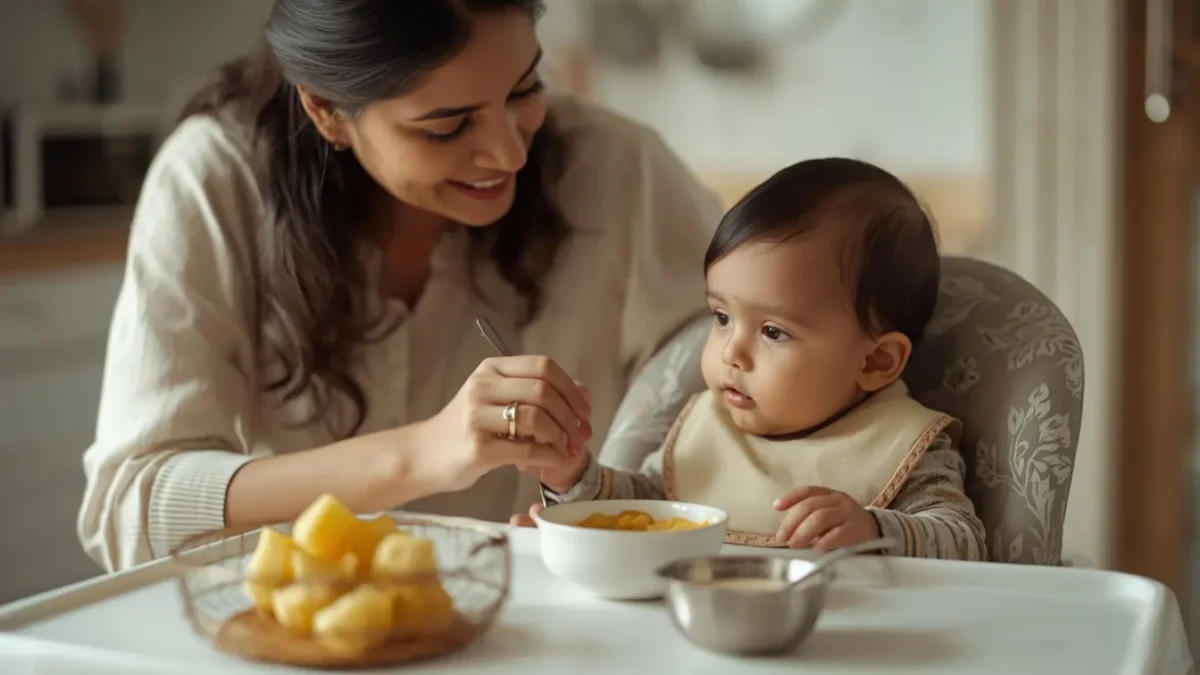
Once your baby has been eating solids for a few weeks, the pace of change picks up noticeably. At seven and eight months, they’re ready for more variety, slightly thicker textures, and a proper feeding routine — not just tentative tastes once a day.
This is also the stage where Indian home cooking genuinely comes into its own for babies. Dal, khichdi, soft sabzis — the foods most Indian families already make daily are well-suited for this age, with just a few simple adjustments in texture and preparation. You don’t need to buy special baby food for this.
Here’s a practical month-wise guide covering 7 month baby food ideas for Indian babies, the 8 month baby food schedule, easy recipes, and honest answers to the questions parents ask most at this stage.
7 Month Baby Food Chart — What Changes Now
By seven months, most babies who started solids at six months have tolerated a range of simple purees and thin porridges. The shift now is toward slightly thicker textures and more variety — mashed foods rather than smooth purees, and combinations of ingredients that have already been individually tested.
According to National Health Mission (NHM) India guidelines (aligned with IAP recommendations), babies at 7–8 months should ideally be offered complementary foods 3 times a day, alongside continued breastfeeding or formula. Portion size at this stage is roughly up to two-thirds of a small 250ml katori per meal, gradually built up over weeks.
The 3-day rule still applies for any completely new food. But at this point, most babies have established enough of a base that you can start combining familiar ingredients more freely.
Also Read Is Aveeno Good for Babies?
7 Month Baby Food Chart (Indian)
| Meal | Food Options | Texture |
|---|---|---|
| Morning | Ragi porridge with a little ghee, or oats porridge thinned with breast milk | Smooth but slightly thicker than month 1 |
| Midday | Moong dal khichdi (soft-cooked rice + dal), with mashed vegetable | Soft mash, small lumps okay |
| Evening | Mashed banana or cooked apple, or soft steamed carrot / sweet potato | Mashed, not completely smooth |
New vegetables to try this month: pumpkin, bottle gourd (lauki), peas (cooked and mashed through a strainer), and beetroot (steamed and pureed). Introduce each one separately over a few days before combining.
8 Month Baby Food Chart — More Texture, More Variety
At eight months, babies’ chewing ability starts developing even without teeth. They can handle soft pieces and mashed textures more confidently. This is often when finger foods become an option — soft bits of food the baby can pick up and bring to their mouth themselves.
The 8 month baby food schedule typically settles into a clear routine of three small solid meals a day alongside breast milk or formula. Portions gradually increase, but always follow your baby’s hunger cues rather than a fixed amount.
8 Month Baby Food Chart (Indian)
| Meal | Food Options | Texture |
|---|---|---|
| Breakfast | Soft idli pieces (no sambhar), ragi porridge, banana mash, or soft upma | Soft pieces or mash |
| Lunch | Dal rice for 8 month old (dal and rice cooked together until very soft), vegetable khichdi with ghee | Soft, slightly textured |
| Evening snack | Steamed vegetable pieces (carrot, sweet potato, pumpkin), soft fruit pieces | Soft finger food sized pieces |
| Dinner | Khichdi, soft rice with dal, or ragi porridge | Soft mash or porridge |
Breast milk or formula continues alongside all meals — it’s still an important part of nutrition at eight months, not something to reduce deliberately at this stage.
Easy Recipes for 7–8 Month Old Indian Babies
Khichdi Recipe for 7 Month Baby
This is one of the most practical, nutritious, and easy-to-digest meals at this stage — and it’s exactly what the NHM guidelines recommend as a complete complementary meal (a combination of cereal + pulse + vegetable).
- 2 tablespoons rice + 1 tablespoon yellow moong dal — washed well
- Cook together in a pressure cooker with 3–4 cups water until very soft (4–5 whistles)
- Mash well with the back of a spoon
- Add a tiny pinch of turmeric and ¼ teaspoon homemade ghee after cooking
- You can add soft-cooked carrot, pumpkin, or lauki into the cooker for extra variety
- Serve warm, cooled to a comfortable temperature
The khichdi recipe for a 7 month baby doesn’t need to be fancy — the simpler, the better. Consistency matters more than variety in the first few weeks.
Soft Vegetable Soup
A mild vegetable broth is useful as a light meal or in-between snack. Carrots, pumpkin, and bottle gourd cook down well and blend into a smooth, gentle soup. If you’re looking for a simple Indian-style recipe to adapt for babies, our broccoli carrot soup recipe works well — just skip any salt and add a tiny drop of ghee instead.
Ragi Porridge with Banana
- 1 tablespoon ragi flour mixed into ½ cup water with no lumps
- Cook on low heat, stirring continuously, until thickened (about 5–7 minutes)
- Cool slightly, then stir in 1–2 teaspoons of mashed ripe banana
- Thin with a little breast milk if needed for consistency
If you’re introducing oats as a grain option alongside ragi, our guide on whether oatmeal is good for babies covers preparation tips and what to look for.
Finger Foods for 7 Month Old Indian Baby
Some babies are ready for soft finger foods by seven months, others not until eight or nine. What matters more than age is whether they can sit steadily with some support, bring objects to their mouth reliably, and are handling mashed textures comfortably.
Safe early finger foods for Indian babies at this stage:
- Soft pieces of ripe banana (no larger than your fingertip)
- Well-cooked carrot sticks — must squash easily between your fingers (this is the safety test)
- Soft idli pieces
- Small pieces of ripe mango or soft pear
- Well-cooked sweet potato cubes
The squash test matters: if you can easily flatten the food between your thumb and finger, it’s soft enough. Anything that holds its shape is a choking risk. Always sit with your baby during meals — never leave them unattended while eating.
Can You Add Spices to Baby Food at 7–8 Months?
Mild aromatic spices in small amounts are generally considered fine at this stage. Indian pediatric practice and trusted sources like babynama.com and practo.com note that baby food does not need to be bland — introducing mild spices actually helps babies develop a palate for family food.
What’s generally okay in small amounts, cooked into the food:
- Turmeric (haldi) — a small pinch in khichdi or dal
- Cumin (jeera) — a tiny tempering in ghee added after cooking
- Carom seeds (ajwain) — sometimes used in traditional Indian baby food
What to avoid: chilli, black pepper, strong garam masala blends, or anything with heat. Salt and sugar should still be kept out of baby food at this age. One important note — avoid “jeera water” or herbal teas for babies; these are not recommended and are different from adding a small amount of cumin while cooking a solid meal.
How Much Water Does a 7–8 Month Old Need?
Small sips of cooled, boiled water can be offered alongside solid meals from this stage — a few sips from a small cup or spoon is enough. Breast milk and formula continue to provide most fluid needs at this age.
Don’t push large amounts of water. Overhydration can be a concern with young babies whose kidneys are still maturing. A few sips with meals is the right approach for how much water a 7 month old baby needs in India’s climate — slightly more on very hot days, but still in small amounts.
Can an 8-Month-Old Have Cow’s Milk?
Cow’s milk as a main drink — replacing breast milk or formula — is not recommended before 12 months. This is a consistent recommendation from WHO, IAP, and most pediatric bodies. Cow’s milk is low in iron, and its high protein and mineral content can be hard on a young baby’s kidneys.
However, small amounts of cow’s milk used in cooking — stirred into porridge or used in a small amount of homemade kheer — is generally considered fine from around 8 months for babies without known dairy sensitivity. This is different from giving it as a drink.
If you’re using formula as a supplement alongside solids, our guide on formula milk for 6-month-old babies covers some basics that remain relevant at 7 and 8 months.
How Many Meals a Day for a 7–8 Month Old?
Based on NHM India guidelines (aligned with IAP recommendations): at 7–8 months, 3 solid meals per day is the target, alongside continued breastfeeding or formula between and after meals.
In practice, many babies build up to this gradually — starting with 2 meals and moving to 3 over the course of a few weeks is perfectly fine. What matters is following your baby’s hunger cues. Appetite varies, especially during teething, growth spurts, or any minor illness. Don’t worry if some days they eat very little.
If you’re ever unsure whether your baby is growing well alongside the feeding changes, a baby weight chart can give you a general reference point — though your pediatrician remains the best guide for individual assessment.
FAQ
What new foods can I introduce at 7 months?
By seven months, you can introduce a wider range of vegetables (pumpkin, lauki, peas, beetroot), soft fruits (mango, pear), grains like oats and ragi, and combination meals like khichdi with vegetables. Continue introducing one new food at a time and watch for any reaction over 3 days before adding another.
Can I give finger foods to a 7-month-old?
Some babies are ready at seven months, others not until eight or nine. Readiness signs include sitting steadily, bringing food to mouth reliably, and managing mashed textures well. Foods must be soft enough to squash flat between your fingers. Ripe banana, soft idli, and well-cooked vegetable sticks are safe starting options.
Is it okay to add mild spices to 8-month baby food?
Yes — mild spices like turmeric, jeera, and ajwain in very small amounts are generally considered appropriate and are part of traditional Indian baby feeding. They should be cooked into the food, not added raw. Avoid chilli, pepper, and heavy masalas. Keep salt and sugar out of baby food at this age. Avoid herbal drinks like jeera water — these are not recommended for infants.
How many meals a day for a 7–8 month old baby?
NHM India guidelines recommend 3 solid meals per day at this stage, alongside continued breastfeeding or formula. Many babies build up to this gradually from 2 meals. Follow your baby’s hunger cues — the target is a guide, not a rule to be forced.
Can I give cow’s milk to an 8-month-old in India?
Cow’s milk as the main drink is not recommended before 12 months (WHO, IAP). It is low in iron and can be hard on infant kidneys. Small amounts used in cooking — stirred into porridge or kheer — are generally considered acceptable from around 8 months for babies without dairy sensitivity. Breast milk or formula should remain the main milk at this age.
Comments
Be the first to leave a comment!